KAMU Station News

KAMU Christmas Programming

With Christmas right around the corner, KAMU-FM and KAMU-TV are here to help you get and stay in the holiday spirit!

ON THE RADIO

KAMU-Classical (HD 90.9-2): Ramping-Up Holiday Music
Our 24/7 classical music HD Radio station, KAMU-Classical, will feature more and more holiday music during Classical 24 programming:

  • Through Dec. 7: 3-5 minutes of Christmas music each hour
  • Dec. 8-14: 5-10 minutes each hour
  • Dec. 15-18: 10-15 minutes each hour
  • Dec. 19-21: 50% Christmas programming
  • Dec. 22-25: 100% Christmas programming

Also on KAMU-Classical:

  • Dec. 20, 4-6 p.m.
    “The Nutcracker Ballet with Mindy Ratner”
  • Dec. 24, 6:01 p.m. and 9:01 p.m.
    “The Night Before Christmas,” narrated by Classical 24 host Lynne Warfel

Not sure how to listen to KAMU-Classical? We have easy instructions for your HD Radio, your smart TV, smart speaker, or simply your phone, tablet or computer.

View the KAMU-Classical schedule.

Start streaming KAMU-Classical now!

90.9 KAMU-FM: All Christmas, All Night
On 90.9 KAMU-FM, we’ll switch to 100% Christmas music beginning Dec. 24 at 7 p.m. and continuing through Dec. 25 at 6 a.m. – a full night of festive favorites.

ON THE TV

PBS KIDS Holiday Specials
All month long, PBS KIDS is rolling out new and classic holiday episodes:

  • “Arthur’s Perfect Christmas” (1-hour special)
    • Dec. 5 at 10:30 a.m.
    • Dec. 19 at 5 a.m.
    • Christmas Eve at 11 a.m.
    • Dec. 26 at noon
  • “Wild Kratts: A Creature Christmas”
    • Premieres Dec. 12 at 5:30 a.m.
    • Dec. 20 at 7:30 a.m.
    • Dec. 24 and Dec. 26 at noon
  • “Peg + Cat Holidays”
    • Premieres Dec. 22 at noon
    • Christmas Day at 10 a.m.

KAMU-TV Holiday Highlights
KAMU-TV is also celebrating the season with special holiday programming:

Kick-off the season with “Hope of the Season: Christmas with the Tabernacle Choir.”

  • Dec. 15 at 7 p.m. and 11 p.m.
  • Dec. 16 at midnight
  • Dec. 22 at 2 a.m.
  • Christmas Eve at 7 p.m. and 11 p.m.
  • Christmas Day at midnight
  • Dec. 26 and Dec. 27 at 2 a.m.

Don’t miss a Christmas classic, “Great Performances: The Nutcracker English National Ballet.”

  • Dec. 16 at 7 p.m. and 11 p.m.
  • Dec. 23 at 8 p.m.

If you’re looking for some Christmas dish inspiration, legendary British baker and chef Mary Berry will show us how it’s done.

  • “Mary Berry’s Highland Christmas”
    • Dec. 22 at 8 p.m.
    • Dec. 23 at midnight
    • Christmas Eve at 2 a.m.
  • “Mary Berry’s Ultimate Christmas”
    • Dec. 22 at 9 p.m.
    • Dec. 23 at 1 a.m.
    • Christmas Eve at 3 a.m.

Wrap up the holiday programming with “Call the Midwife: Christmas Special.”

  • Premieres Christmas Day at 7 p.m.
  • Re-airs Dec. 26 at midnight

We hope you enjoy this Christmas programming as much as we do. Happy Holidays from all the staff at KAMU!

More Than a March: Inside the Aggie Band with Head Drum Major Natalie Holder

Before the sun rises on most fall days in Aggieland, Natalie Holder ’26 is already on the Dunlap Drill Field. Around her, the steady rise of brass and percussion slowly fills the air as
another day comes to life.

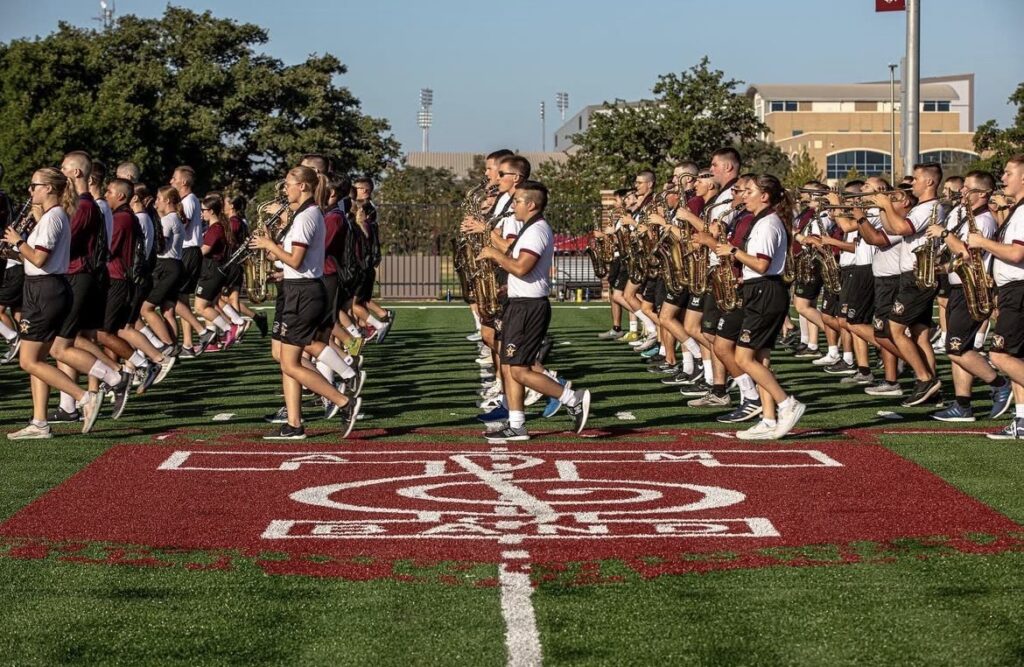
The first female head drum major in the history of the Fightin’ Texas Aggie Band, Holder leads the over 400 cadets through early-morning warmups and hour-and-a-half long rehearsals that most fans never see. 

Natalie Holder ’26 leading the Aggie Band during march-in for the season opener on Aug. 30, 2025, against the University of Texas at San Antonio (UTSA).
Photo by: Abbey Toronjo/Texas A&M University, Division of Marketing & Communications

A First in the Ranks

No one understands this rhythm quite like Holder, a senior set to graduate in May with a biology degree. Her distinction as the first female head drum major is historic, but Holder does not consider it a platform for personal recognition. To the 21-year-old, the role is about duty and service, not visibility.

As a fourth-generation Aggie, Holder grew up around Texas A&M football. She remembers the heat of an afternoon game, the stands filled with maroon, and the powerful sound of the band carrying across the field. She did not fully understand what she was seeing. That changed during a high school visit.

“I fell in love with the family aspect of it,” Holder said. “Everyone was welcoming and already seemed like family. I knew if I did not have something like the Corps and the Band, I would be really isolated in college.”

Her story is bigger than a milestone. It’s part of a lineage of Aggies who found belonging, purpose and lifelong bonds as the traditions are passed from one class to the next. Through the voices of former band members across generations, this story explores what the Aggie Band gives its students and why those who have lived it say the experience stays with them forever.

The Fightin’ Texas Aggie Band performing in Kyle Field during the 1968 football season.
Photo provided by: Aggie Band – 1961-1970 – 8 by Cushing Memorial Library and Archives, Texas A&M, CC BY-NC-ND 2.0

Tradition That Spans Generations

That search for belonging has carried generations of Aggies to the drill field. Tim Green ’86 remembers the same pull. His father marched in the band in the 1950s, and stories of camaraderie and pride filled his childhood. “I wanted to be part of something bigger than myself. Something built on tradition and excellence,” Green said. 

Former band commander Ryan Knape ’04 also felt that call. For him, the bond among his peers remains the most defining part of his experience. “You form lifelong friendships. You carry the lessons with you forever.” 

The eras differ. The uniforms evolve. Yet the sense of belonging stays the same, former students said.

The Year That Changes You

Every band member remembers his or her freshman year. For many, it is the hardest two semesters they ever experience. Tim McMillan ’15 can still describe it clearly. “The sophomores would kick open your door at 5:30 a.m. and start yelling at you,” he said. “But you do everything with your buddies. That is what gets you through.” 

The pressure forms something more than endurance. It forms connection. For McMillan, that connection became life-changing. “I lost my dad right as I started college,” he said. “The Band was there for me. They gave me the backing I needed to get through that. I was not alone.” Most fans will never see these moments. Yet they are the reason the band feels like family long after graduation.

The Aggie Band rehearsing for the first halftime performance of the 2023 season.
Photo provided by: Fightin’ Texas Aggie Band Instagram

The Work No One Sees

The public sees the final performance: the crisp steps on Kyle Field and the coordinated music that fills the stadium. Holder explained how much must happen before that moment can exist. “We spend hours out there, memorizing the music and the drill and then putting them together until it looks effortless,” she said. “By the time Saturday comes, it is automatic.”

Learning a halftime show begins long before the first note is played in front of a crowd. Green, a retired major general in the U.S. Air Force, now serves as a Director at the George H.W.
Bush Combat Development Complex at the RELLIS campus. He remembers how the planning starts quietly. The bugle rank studies charts, diagrams, spacing and how hundreds of cadets can move at once without breaking a line. Monday rehearsals are slow and exact. Every member has a spot on the field and then finds the path that takes them there in time and in step.

“You spend most of Monday and Tuesday just trying to figure out where your feet go,” McMillan said with a laugh. “Then you add the horns back in. Then you do it again. And again.” 

By Wednesday, the band begins merging sound with motion. The drill becomes smoother. The music becomes stronger. By Friday, the show begins to resemble what the audience will see. Formations sharpen. Angles match. The field feels alive. 

“There are rehearsals where it is 100 degrees and you are running it for the fifth time,” Holder said. “But everyone stays. Everyone finishes. Because you know what it is building toward.” 

Perfection is not accidental. It is the result of repetition, patience and a shared understanding that the Saturday performance is not just for the 100,000 or so fans seated in Kyle Field. It is for one another.

“You are marching right past families and little kids,” Knape said. “You do not want to be the one to mess up. But it is the best feeling in the world.”

The Aggie Band entering Kyle Field before kickoff at the football game against UTSA on Aug. 30, 2025.
Photo by: Laura McKenzie/Texas A&M University, Division of Marketing & Communications

Game Day in Full Rhythm

Game day starts the night before — at Midnight Yell Practice. Cadets return to their rooms close to 1 a.m., only to rise again at dawn. Uniforms are pressed, horns polished and their boots shine in the hallway light. The pace is relentless but familiar.

After morning rehearsal, cadets gather on the Quad for step-off. The drumbeat begins. The band straightens into formation. Holder gives the signal and the cadence begins. Hundreds of students and visitors line the path, anticipation filling the air.

“When you take that first step and the crowd starts cheering, you feel the weight of every band that came before you,” Holder said.

The march to Kyle Field is loud and energetic yet deeply disciplined. Horns stay angled, rows remain straight, cadence steady. The band enters the stadium as one moving body, not as individuals.

Halftime arrives in a blur. The band performs a show that took a week to perfect. After the game, if the Aggies win, the band gathers again for Victory Yell. Exhaustion sits in their shoulders, but so does pride, ending the day as it began: surrounded by the same people who stepped onto the drill field that morning.

The Fightin’ Texas Aggie Band performing in Kyle Field during the 1974 football season.
Photo provided by: Aggie Band – 1971-1980 – 13 by Cushing Memorial Library and Archives, Texas A&M, CC BY-NC-ND 2.0

Moments Most People Never See

McMillan laughed when remembering one of the Aggie Band’s less formal traditions. “There are about 2,015 different traditions I could tell you about, but I think one of my favorite traditions of all time from the Aggie Band is Fish Band. First-semester freshmen have no idea it’s coming, but the seniors take the freshmen out, parade them across campus with their instruments, and everyone watching laughs along,” he said. “One of the best memories I had was when we went up to Sbisa. They said, all right, we’re committing, and we marched through the fountain at Sbisa as fish, with our instruments and everything. Sbisa is a lot deeper than people think it is. It’s up past your knees.”

Green’s memories from the 1980s mix discipline and mischief. “We had our serious side, but we also knew how to have fun. You spend that much time together, and you find ways to keep things light,” he said. “There were nights when we’d be up late polishing boots or cleaning horns and someone would start telling stories or pulling harmless pranks, and before long everyone was laughing. Those are the moments you remember.” 

Knape recalled quieter rituals, like performing at Silver Taps. “You don’t talk about it while you’re there because the focus is on the fallen Aggie, not the players. We would practice late at night, sometimes in hidden places, because you really do want to respect that anonymous side of the tradition. It’s one of those behind-the-scenes things most people never see.”

Leadership That Listens

Leadership in the Aggie Band is about care, attention and presence, not rank. Knape, now a Senior Vice President at Texas Capitol Bank, said that serving as band commander shaped how he leads today. “You learn to care about what people are going through. You learn to lead by listening,” he said.

Holder carries the same mindset. 

“Being drum major does not automatically mean you have influence,” she said. “It just gives you the platform to influence others.” On game days, young girls often run up to her, smiling and excited at seeing her lead the group. “Being female has not made it any different on my end. But it means something to them. And that is really special.” 

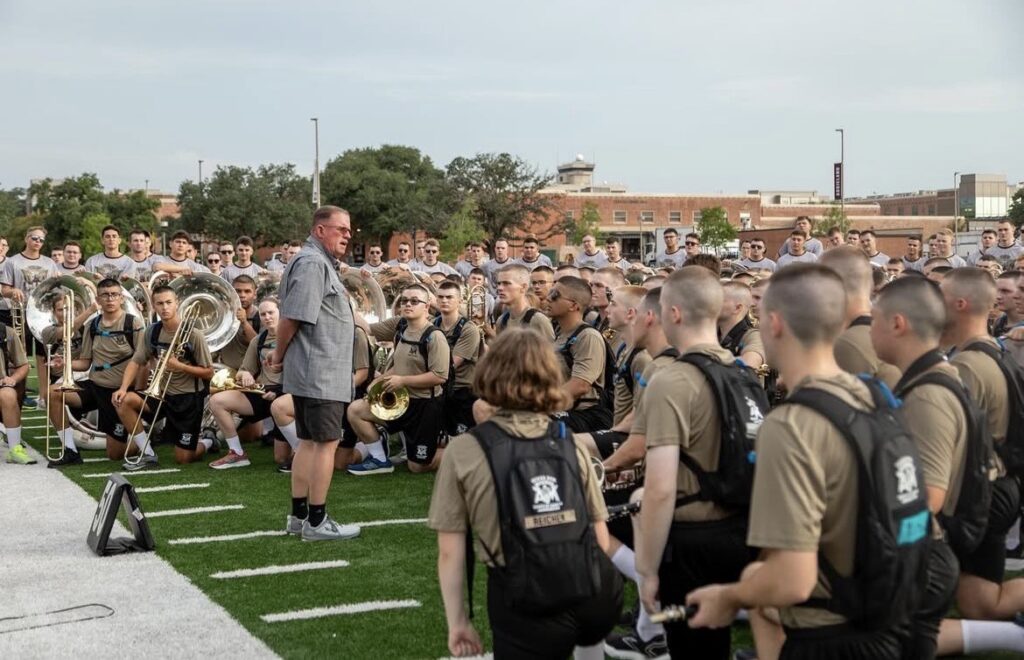
Former Aggie Band Director, Col. Jay Brewer ’81, speaking to band members of the class of 2029 during Freshman Orientation Week on Aug. 21, 2025.
Photo provided by: Fightin’ Texas Aggie Band Instagram

Carrying the Baton Forward

McMillian recalls a quote Col. Jay Brewer ’81, longtime band director, once said to him, “The most important thing in the Aggie Band is not what you do, when you do it, or how you do it, or even why you do it. The most important thing is who you do it with.”

Texas A&M Student Stuns ‘The Voice’ Judges – Again.

Texas A&M sophomore and College Station native Aiden Ross wowed ‘The Voice’ judges this week, advancing to the next round, which will be televised on NBC Monday, Nov. 10, at 7 p.m.


In his third appearance in front of a national audience, Ross’s soulful performance of Billie Eilish’s “when the party’s over” energized the show’s judges, the studio audience, and fans across the country.


“I was ready to give everything to the crowd. When I was announced as the winner, I was ecstatic and incredibly grateful, but I was ready to get on to the next round,” Ross said. “The farther I’ve made it in the competition, the more I’ve been like, ‘I really want this. I really want to stay. I really want to show them that I have more in me.’”


Ross’s recent success is the culmination of a somewhat unlikely path. His passion for music started when he was 4 years old, but it wasn’t until his junior year in high school that he began singing publicly. Then Ross first applied for ‘The Voice’ during his senior year at A&M Consolidated High School, but didn’t advance far into the audition process. Instead of being discouraged, the experience guided him to A&M, where he joined musical organizations like Hardcore Dynamics, a student acapella group.


“In hindsight, it’s been the best thing that could’ve happened,” Ross said. “I’ve grown so much as a singer, a performer and a person. That’s what led me to reapply my freshman year and to where I am today.”


When show producers called him back, Ross immediately booked a flight to Los Angeles. During his blind audition in September, he impressed the judges almost immediately: mere seconds into his performance, all four of the show’s judges spun their chairs around – a clear sign they heard something technically flawless.


“It felt like I had hardly even gotten a note out when I saw Snoop Dogg turn his chair, then Michael Bublé, then Reba McEntire, then Niall Horan,” Ross said during a recent interview at Aggie Park on the Texas A&M campus.


Soon, it would be time to choose a coach from the four superstars. Because he was drawn to Horan’s musical style and perspective, Ross trusted his instincts and joined Team Niall. Horan is a former member of the boy band One Direction and is now an award-winning solo pop artist.


“He writes and makes music that is most similar to the type of artist that I aspire to be,” the 20-year-old said. “He’s the youth of the show. It was the right decision for me at the right time, and it’s been a great experience.”


Aside from the support of the judges, Ross is grateful for the other contestants with whom he shares this intense, but extraordinary experience.


“The pressure of being aired in front of millions and millions of people, side by side, with the loving and supportive community that is ‘The Voice,’ gave me lifelong friendships.”


With all eyes on him, Ross has stepped onto one of television’s biggest stages, but he said he’s not giving up the small-town venues he loves.


“First Friday (the monthly event in Downtown Bryan) is one of the most special gigs I’ve gotten to play, and I hope to continue to play it, no matter what happens,” Ross said.


In fact, Aggieland continues to be where Ross feels the most love.


“I was astonished at the level of support I’ve received walking around at the tailgates and people coming up to me, sharing such kind and supportive words,” he said. “If you see me, say what’s up. I’m just a dude. It means the world to me, and I would love to talk to you.”


You’ll have a chance to see Ross perform live – likely to a larger audience than usual – at The Palace Theater in Downtown Bryan on Wednesday, Nov. 12, at 7 p.m.


Although his career is still gaining momentum, albeit under a national spotlight, Ross shared some words of encouragement for others seeking a similar path.


“I wasn’t motivated to play my guitar all the time or write songs all the time or to play gigs all the time, but to have the discipline to do something will take you so far beyond music.”


Regardless of the show’s outcome, Ross said he wants to finish his degree in Industrial Distribution Engineering while continuing to pursue his passion for music.


“The decision on what I do after the show is based on what opportunities arise,” he said. “If something in music pops up that is a viable opportunity, I will jump at it. If there’s a spark, I’m gonna fan that flame.”


“I wouldn’t be where I am today without the Bryan-College Station community, so I feel like it’s a joint effort,” Ross said. “I seriously am just so grateful to be where I am.”

Local Radio is at the Heart of Aggieland

This article is just one of several ways we’re celebrating National Radio Day. Radio superstars of Bryan-College Station past and present joined KAMU for a National Radio Day special of Brazos Matters. Don’t miss it!


Every year on Aug. 20, National Radio Day acknowledges the impact of radio. Although radio has evolved over the years, it still serves the same purpose. Whether you tune in for the latest songs from your favorite artists or use it as a tool to stay up-to-date on current events, radio is a powerful instrument for communication.

At KAMU-FM, it’s our pleasure to be Aggieland’s Public Radio, housed at Texas A&M University. While national programs like NPR’s “Morning Edition” and “BBC World Service” allow listeners to hear news and stories from around the world, KAMU-FM offers 13 local shows and podcasts that are catered specifically for the Brazos Valley.

Through programs like “But Beautiful,” “Tuesday Evening Jazz,” “The Heart of Art,” “Brazos Matters” and “Waterful Wednesdays,” KAMU-FM can provide music that you want to hear and interview shows that are relevant to the community.

We Love Our Local Hosts!

Because local voices host each program, they understand the needs and wants of the Brazos Valley community. For these local hosts, radio isn’t just a job, it’s a lifelong passion.

KAMU Associate Executive Director and “Brazos Matters” host Jay Socol has high hopes for the future of the local radio industry, as he explains in this audio clip below:


Listen to “Brazos Matters” on Sundays at 2:30 p.m.

KAMU’s “Tuesday Evening Jazz” host Jennifer Cotton says her passion for volunteering is what keeps her hosting the show. Listen to what she has to say:


Join Jennifer Cotton for “Tuesday Evening Jazz” on Tuesday evenings from 7-9 p.m.

Bill Clark, host of KAMU’s “But Beautiful,” wants to bring attention to the significance of radio through his jazz show, that and more in the audio clip below:


Tune in to “But Beautiful” with Bill Clark on Wednesdays from 7-9 p.m.

But what happens beyond the microphone and headset?

KAMU Associate Director of Engineering Wayne Pecena is a nationally recognized broadcast engineer who has worked at KAMU for over 50 years. Having witnessed much of the evolution of radio, Pecena knows what it takes to make a local station succeed. Hear Wayne’s story and perspective:


Thank you for tuning in to KAMU-FM and celebrating National Radio Day with us! We’re honored to be the Brazos Valley’s premier local public media station, housed straight from the heart of Aggieland.

A Dinosaur Named Easton: How a Rare Fossil Almost Ended Up in the Brazos Valley

The legend is back: “Walking with Dinosaurs” returns to KAMU. Meet six iconic dinosaurs emerging from incredible dig sites and discover stories of struggle, love and survival. Watch the three-night event on June 16-18 from 7-9 p.m. on KAMU-TV or our online livestream.

Did you know the Brazos Valley almost became home to a rare dinosaur fossil? Here’s its story:


Wouldn’t it be cool to have a dinosaur named after you?

The legendary animals have captivated human interest — and wallets — since the word ‘dinosaur’ was coined in 1852. They dominate toy aisles. We all probably know kids who can recite numerous dinosaur names and facts. And they’ve been key parts of literature, movies and theme parks. For example, the “Jurassic Park” movie franchise has earned over $6 billion worldwide at the box office.

Many dinosaur fossils are nicknamed after the people who discovered them. There’s “Sue” the T. Rex in Chicago and “Stan” the T. Rex in Abu Dhabi. Some are given a ferocious name, like “Apex” the Stegosaurus in New York City.

At the Smithsonian National Museum of Natural History in Washington, D.C., there’s a Nodosaur fossil nicknamed “Easton,” after a three-year-old boy from Austin.

Someday, it will be the ultimate flex for Easton. What little kid wouldn’t want a dinosaur named after them? He may never meet another kid that lucky. Maybe he’ll even want to visit his dinosaur. For now, though, he just wants to get into Dad’s home office to play with his fossil collection.

“He is not allowed to come in here unsupervised,” said Dr. Binh Pham, Easton’s father, with a laugh. “He loves T. Rex. He loves Brachiosaurus. He loves Triceratops. But a three-year-old can drop a very expensive fossil.”

Pham is a gastroenterologist based in Austin, but in his free time, he’s a passionate dinosaur enthusiast and private fossil collector.

“It’s one of those fascinations that starts at a young age,” Pham said. “Most of us grow out of it to some degree — I didn’t.”

Tastefully placed fossils and replicas fill his office. He travels to Montana or Wyoming nearly every year to dig for fossils for a few days. He dedicates considerable time and money to his hobby and hopes Easton will follow in his (dinosaur) tracks.
Binh Pham digs for fossils

“Dinosaur names are some of the first words that he spoke,” Pham said. “But I’ve told my wife that if it turns out all he likes about fossils are movies and stuffed animals, then I will donate my collection for the world to see.”

The dinosaur that shares Easton’s name is at the Smithsonian because of Pham’s philanthropy. After purchasing the fossil from a friend in 2019, Pham donated the 110-bone fossil — one of the most complete Nodosaurs ever found — to the museum for research in 2022.

Originally found in Wyoming in 2012, scientists at the Smithsonian believe it’s an undescribed species of Nodosaur.

“It’s especially significant because Nodosaurs are rare fossils in that particular time and place,” said Dr. Matthew Carrano, the curator of dinosauria at the Smithsonian. “Any new examples are scientifically valuable. This specimen has a lot of the armor and some of the skeleton preserved together and that makes it even more important.”

Pham was floored at the chance to donate something so significant to the Smithsonian. But this fossil didn’t go straight from Wyoming to Washington. It almost ended up at the Brazos Valley Museum of Natural History in Bryan.

A Museum-Changing Opportunity

Dr. Deborah Cowman’s museum will never be confused with the Smithsonian. She knows that. It’s attached to the Brazos Center in Bryan, hidden behind a shopping center, and for the most part, all exhibits and collections share one large space. But don’t tell that to her ambition.Entrance to the Brazos Valley Museum of Natural History

“You can be small but still be good,” said Cowman, the executive director of the Brazos Valley Museum of Natural History. “We always joke that we’re like the mouse that roars.”

She passionately believes the Brazos Valley community deserves a high-quality natural history museum. Cowman pushes her team to create influential and engaging children’s camps, outreach programs and exhibits. The museum was established in 1961 after Texas A&M University closed its on-campus exhibition.

“Scientists who grew up in this area tell us they got their start in natural history or science through our camps,” Cowman said. “They found their inspiration here.”

The camps are a shining example of the museum’s impact on the community. Ultimately, though, a museum needs to display interesting things to bring people in. What provides those interesting things? Money — or relationships. In the case of the Nodosaur fossil, it’s the second one. Dinosaur exhibit at the Brazos Valley Museum of Natural History

“I instantly connected with Deborah because of her enthusiasm, energy and drive,” Pham said. “The Brazos Valley museum is kind of this museum that can.”

When Pham purchased the Nodosaur fossil, he originally intended to display it in his home. When he started to piece the fossil together, he realized it would be nearly 20 feet long and might be more appropriate as a museum display.

“I had the opportunity to donate it to other museums,” Pham said. “But I didn’t know if they would put it in a box, add it to their other material in the back, and never look at it again. I knew the Brazos Valley museum would display it and appreciate it.”

The Prestigious Twist

A Nodosaur armor plate after being unearthedBefore the fossil could be donated, the 110 bones needed to be prepared. Pham shipped them to Georgia, enlisting the help of the late Dr. Steve Nicklas, an archaeologist and paleontologist who originally discovered the fossil.

When Nicklas began reviewing the bones, unusual armor plates caught his eye. They seemed out of place for what he knew about Nodosaurs. He took pictures and sent them to the director of the Smithsonian museum. Impressed and surprised, the director believed the plates might indicate a new species. That’s when the once-in-a-lifetime request happened: would Pham donate the fossil to the Smithsonian?

“I was like, ‘holy cow, that’s unbelievable,'” Pham said. “The holy grail of museums. You don’t turn them down.”

Pham was elated with the opportunity. But he also felt bad, knowing how excited the Brazos Valley museum was to receive the fossil. Cowman said she remembers feeling “bittersweet.”

“On one hand, I was a little disappointed, but on the other hand, I was so happy that such an important discovery was going to a major institution,” Cowman said.

Pham asked Nicklas to make a replica of each bone for a custom-made display mount. He still wanted to give something to the Brazos Valley museum and thought a beautiful replica would be the next best thing. The museum unveiled the replica in 2023, showing an interpretation of the fossil at a dig site.

The Nodosaur replica on display at the Brazos Valley Museum of Natural History.

Since the real fossil is behind closed research doors at the Smithsonian, the replica in Bryan-College Station is the only version of this dinosaur on display anywhere in the world — a one-of-a-kind experience for museum visitors.

“Being able to work with people like Binh Pham has added a wonderful dimension to our museum,” Cowman said. “In many ways, this has elevated us.”

Frithiof’s Fossils

Ron Frithiof standing next to one of his fossils.When we look back, we often see threads that tie parts of our lives. In this case, there would be no donation, no Nodosaur fossil and no ties to the Brazos Valley museum without fossil collector Ron Frithiof.

“When I started seeing people with fossils, I thought, ‘I’ve only seen these in museums,'” Frithiof said. “It kind of hit me: it’d be cool to find something like that myself.”

Frithiof lives in West Texas but travels to prime fossil-hunting land in Montana or Wyoming for at least a week each year.

“Fossils don’t come in a Walmart bag,” Frithiof said. “I can go days and not find anything. But I know that eventually I’m going to walk over to the right spot and look in the right direction at the right second and find something interesting.”

Frithiof helped dig up Pham’s Nodosaur fossil in Niobrara County, Wyoming, from 2012 to 2014. He was good friends with Nicklas, the archaeologist who initially discovered the fossil and later created the replica display.Crew members dig up the Nodosaur fossil.

“He called me one day and said, ‘I think we found something pretty cool, you need to come up and take a look,'” Frithiof said. “You hardly ever find a complete dinosaur. But we spent a few days digging test holes and figured out that it was a mostly complete animal.”

For the next three years, Frithiof, Nicklas and some of his students from Georgia spent a few weeks each year slowly unearthing the fossil. They found armor, a piece of the jaw, some of the skull, most of the ribs and vertebrae, and more. Once they excavated all 110 bones, the fossil went home with Frithiof to Texas.A Nodosaur dorsal vertebrae shortly after being unearthed.

“I kept it in my house for a few years, waiting for the right person and the right opportunity,” Frithiof said.

Frithiof and Pham met about six years ago and quickly bonded over their love for dinosaurs. Pham often joins Frithiof for his annual fossil-hunting pilgrimages.

“The Earth has buried these creatures in the ground,” Pham said. “If you’re lucky enough to find something, you’re the first person on Earth to ever lay eyes on it.”

When Frithiof suggested Pham buy his Nodosaur fossil, Pham initially thought it was a crazy idea. He changed his mind when he saw the fossil. But where to put it? That’s when Frithiof introduced Pham to the Brazos Valley museum. After being introduced to the museum by an archeologist friend at A&M years ago, Frithiof has loaned the museum many fossils and artifacts of various sizes and values.

“The museum is kid-friendly and interacts with the public,” Frithiof said. “Not every museum does that.”

Dinosaur Envy

While they may never discover another complete fossil, Frithiof and Pham continue to find interesting items during their trips.

“They say a bad day of fossil digging is better than a good day at work,” Pham said. “You can spend nine hours in the hot sun and not find anything. That drive to find that piece of fossil that’s hidden from the world… you realize how insignificant and small you are in the greater scheme of life. How humbling is that?”A diagram map of the original Nodosaur dig site.

There is some controversy in the dinosaur community about hobby hunters. Many paleontologists believe that finding fossils should be left to professionals who approach the task with scientific care, rather than hobbyists who might only care about money or the thrill. Frithiof has faced these criticisms for years.

“I’d love to see academics work with private fossil hunters,” Frithiof said. “Working as a team is always better. So much more could be uncovered.”

According to Frithiof, there are millions of acres in the Western United States concealing an immeasurable number of fossils. Rock formation and shifting tectonic plates slowly bring fossils to the surface, where rain erodes sediment. Suddenly, there’s a fossil ready to discover. Frithiof says it’s a race against time. If fossils aren’t collected and studied, they’ll be gone.

“They can be under the ground for years and years, but once they’re exposed to the elements, they disintegrate quickly,” Frithiof said. “Between rain, freezes and thaws — if you’re lucky, they last one year exposed.”

Easton the Nodosaur

To bridge the divide between private collections and scientific knowledge, Pham hopes more hobbyists will donate their important fossils.

“Things that will contribute to science should be donated,” Pham said. “That’s how I’ve tried to live my life since I’ve been fortunate to obtain some of these amazing specimens.”

The Smithsonian recently finished conserving the Nodosaur fossil that Pham donated, and it’s now a part of their permanent non-display research collection.

“It will be kept safe for decades to come,” said Carrano, the curator of dinosauria at the Smithsonian. “I’m excited to study it and learn more about these uncommon animals.”Easton, the 3-year-old son of Binh Pham

Someday, the fossil will have a scientific name. But a perk of donating a fossil to the Smithsonian is the opportunity to give it a nickname. That’s how Pham got the chance to name the dinosaur after his son, Easton.

Pham and his wife are expecting the birth of their daughter any day. There probably won’t be a dinosaur named after her in the Smithsonian, though. Pham got the chance to donate a second rare fossil to the museum last year. Another Frithiof fossil, this one had been on display at the Brazos Valley museum for 16 years. Pham named it “Ronny” in honor of his friend. Now that he’s donated two rare fossils to the Smithsonian, he feels he’s used up all his luck.

“Donating to the Smithsonian is a once-in-a-lifetime chance, and I got two opportunities to do it,” Pham said. “I don’t know if it comes in threes.”

At the Brazos Valley museum, the Nodosaur replica is known as Easton, too. Seeing people enjoy the rare piece of natural history makes a happy dad even happier.

“Every time I see it or see people post about it, it makes me happy that the community of Bryan-College Station can appreciate it,” Pham said.

“I now realize that something of that significance sitting in my living room — though it would be appreciated by me and my family — would be lost to the world.”


The epic three-night program “Walking with Dinosaurs” airs June 16-18 from 7-9 p.m. each night on KAMU-TV or our online livestream. Check out the series trailer and get ready to travel back to the time of the dinosaurs. 

Summer Fun with PBS KIDS & KAMU!

It’s summertime! School’s out and that means kids need fresh ways to stay busy and keep those thinking caps on. At KAMU, we strive to provide engaging educational content that inspires and enriches young learners. PBS KIDS has the perfect collection of fun activities that foster everyday learning for kids of all ages.

We’ve compiled a guide to all the resources KAMU & PBS KIDS have to offer to stay bright this summer!

PBS KIDS Games

PBS KIDS Games

Learning goes beyond the classroom! Through PBS KIDS Games, children can learn for fun and for free. The PBS KIDS Games website and mobile app feature classics like “Wild Kratts,” “Daniel Tiger,” “Clifford,” “Sid the Science Kid” and so many more with hundreds of options. It’s ad-free and safe for kids ages 2-8 who can engage in subjects like math, reading and art alongside their favorite PBS KIDS characters as they unleash their creativity. This child-friendly playing experience can easily be accessed from home, on the road or anywhere you have your device. Download the PBS KIDS Games app or visit the PBS KIDS Games website today!

PBS KIDS Podcasts

Arthur wears headphones and waves at the camera

Podcasts are more popular than ever, so some of our favorite PBS KIDS characters decided to join the action. Eight PBS KIDS podcasts feature exciting stories and educational episodes that dive into the worlds of PBS KIDS classics. Tune in to “The Arthur Podcast with Arthur Read,” “Work It Out Wombats! Podcast,” “Odd Squad: Odd Squadcast!,” “Molly of Denali Podcast” and more anywhere, anytime through the PBS KIDS website, Apple Podcasts and Spotify.

PBS LearningMedia

PBS Learning Media

As the No. 1 educational media brand for children, PBS prides itself on providing free educational content and lesson plans for grades pre-K through 12. From Health & Physical Education and the Arts and Mathematics to more intricate topics like Professional Development and Engineering & Technology, the PBS LearningMedia site caters to kids of all ages. With educational videos, audio recordings and interactive activities, there’s a wide variety of content to choose from. PBS LearningMedia is just one of the many great resources PBS offers to sharpen minds during the long summer break!

KAMU Community Calendar

Girl takes a picture of her friends with a Curious George cutout.

Want to take a break from screen time? Our KAMU Community Calendar features tons of fun family activities happening right here in the Bryan-College Station community. From summer camps to movie nights, and of course First Friday in Downtown Bryan, you’ll find fun ways to keep the family busy with some fun under the sun. Access the KAMU Community Calendar to stay up-to-date with what’s going on in our community.

KAMU Kids Corner

KAMU Kids Corner

At KAMU, we love families! KAMU Kids Corner is our hub for everything PBS KIDS. Let your child’s imagination run wild and visit KAMU Kids Corner to access the PBS KIDS TV schedule, PBS KIDS educational games, free printable PBS KIDS-inspired coloring pages and discover what KAMU is up to in the Bryan-College Station community.

Don’t forget that you can stream your favorite PBS KIDS shows for free and on demand.

From PBS KIDS Games to local KAMU Community Events, we’ve got summer education and entertainment covered!

Edward Gorey Exhibit to Delight PBS Fans

Longtime PBS fans will undoubtedly remember the “Mystery!” series and its iconic, hand-drawn animated opening. Artist Edward Gorey created the spooky illustrations that opened the show from 1980-2007. His characters still live on in the “MASTERPIECE” intro used for mystery programs since 2008.

But there’s a lot more to Gorey than the “Mystery!” illustrations. His extraordinary range is now on display in an exhibit at Texas A&M.

“Ubiquitous Edward Gorey” is now open at Cushing Memorial Library & Archives through Sept. 17. The free exhibit showcases his 50-year career and features more than 600 items, especially unknown drawings and paintings from Gorey’s youth, first editions of his early primary books and other rare materials.

Gorey’s creativity had no bounds. He designed sets for the 1977 Broadway revival of “Dracula.” He authored and illustrated more than 100 of his own books, and fully illustrated, drew covers, chose typography and designed hundreds of books by authors including T.S. Eliot and H.G. Wells. He also designed costumes and sets for ballets and operas, illustrated magazine stories and articles, and created advertising artwork.

Edward Gorey fans enjoy the opening day of the Gorey exhibit at Texas A&M.
Gorey-Exhibit-2
previous arrow
next arrow
 

“Rather than a gloomy, brooding hermit, as he has often been described, Gorey appreciated the company of friends and family,” according to collector and co-curator Patrice Miller. “He was a brilliant, talented, fun-loving person who left behind a vast trove of work to study and enjoy.”

This exhibit provides the unique opportunity to view the broadest range of Gorey’s work ever shown in one location, outside of the Edward Gorey House Museum. It’s a perfect outing for the biggest PBS fans in our area.

Cushing is located in the central section of Texas A&M’s campus. Exhibition hours are 9 a.m.-4:30 p.m., Monday-Friday, excluding holidays. Visit the library’s website for more information.

Behind the Barbecue at Troubadour Fest 2025

Award-winning barbecue joints from across Texas and country musicians from around the nation: we bet you can’t name a better combination. The Troubadour Festival returned to the shadows of Kyle Field in Aggie Park on Saturday, May 19, for the third year in a row.

Three College Station-area restaurants attended the festival. This year, KAMU wanted to highlight the people behind the barbecue — the pitmasters — and the origin stories of their establishments. Their passion for barbecue is just a glimpse into a profound dedication to giving back to the community.

The first tent we stopped at was 1775 Texas Pit BBQ, locally owned and operated by the Doans, a military family. The name is a tribute to the year the U.S. Army was founded. Brad Doan, co-founder and pitmaster, says College Station is home and means everything to him.

“This town has done a lot for us and meant a lot to us,” Doan said. “We always wanted to have something to come back to and have a business that we can call our own.”

1775 BBQ building nachos at Troubadour Fest.

From Coach Blair’s Charities to Hospice Brazos Valley, 1775 BBQ aims to serve others.

“We help support the local community because of how much they come out and support us,” Doan said.

Right next door at the festival: LJ’s BBQ out of Brenham, Texas. Matt Lowery, co-founder and pitmaster, credits much of his restaurant’s growth to the community. What started as a backyard hobby quickly became a full-time job. With the help of his cousin, Corey Cook, LJ’s became a reality. The name is a tribute to their late grandmother, Laura Jean.

“She would always say she didn’t like barbecue because it was too smoky for her, but she was a great cook,” Lowery said. “Growing up, we loved going to her house, eating good food and spending time with family.”

LJ's BBQ prepping plates to serve to festival attendees.

LJ’s BBQ enjoys donating to athletic teams and organizations from local schools to give back to the community that takes care of them.

“They’re the ones who keep our business alive,” Lowery said. “We try to do everything we can to support them in as many ways as we can.”

Just a couple of tents away was the Bar-A-BBQ tent, a business from Montgomery, Texas. Co-founder and pitmaster Caleb Abercrombie works alongside his brother and sister-in-law, Cooper and Shelby. The Abercrombie brothers started their barbecue journey by experimenting on the grill and getting feedback from local school teachers and football coaches.

“We felt like this was our purpose: serving food and trying to make it as good as possible,” Caleb Abercrombie said. “For us to be able to have an established business and be somewhat successful in the town that we grew up in, around the people we grew up with, is such a blessing for us.”

Bar-A-BBQ slicing brisket for festival attendees.

He describes Bar-A-BBQ as a faith-oriented business.

“You walk out of the back door, and you just see friends and families all over the place breaking bread together and having actual conversations,” he said. “We get so far away from that sometimes, and it’s really cool that we can offer that to our local community, friends, and family. It’s very humbling.”

From a backyard hobby to a successful business, there’s a story behind the barbecue, and it’s evident that each pitmaster shares a love for their community. There’s no better place to try some of the best food with the best stories than Troubadour Fest in Aggieland!

Sesame Street to Continue Airing on PBS KIDS

TV’s sweetest and funniest monster friends aren’t going anywhere. KAMU is excited to share that “Sesame Street” will continue to air on PBS stations across the country, extending the 50+ year history of one of the most iconic children’s programs of all time.

On May 19, 2025, PBS announced a new multi-year agreement with Sesame Workshop, the nonprofit behind the show. The agreement is a unique public-private partnership with Netflix, allowing new episodes to air for free on PBS and stream on Netflix on the same day. Episodes will also be available on PBS digital platforms, including the PBS KIDS webpage, the PBS KIDS Video App and the PBS KIDS YouTube channel. Additionally, new games will be produced for the PBS KIDS games website and app.

Season 56 will debut on KAMU later this year. The show has raised multiple generations of American children and is actually a few months older than KAMU, first launching on the PBS predecessor, NET, in November 1969, three months before KAMU-TV’s debut.

“I strongly believe that our educational programming for children is one of the most important aspects of our service to the American people, and “Sesame Street” has been an integral part of that critical work for more than half a century,” said Paula Kerger, the president and CEO of PBS. “We’re proud to continue our partnership in the pursuit of having a profound impact on the lives of children for years to come.”

The future of “Sesame Street” had been uncertain since HBO Max decided to let its streaming contract with Sesame Workshop end. This new partnership serves to secure the show’s future and allow more children to experience the heartfelt, engaging program for free.

“Sesame Street” currently airs on KAMU every day at 9 a.m. and on the 24/7 PBS KIDS channel at 5:30 and 7 a.m. on weekdays and 7 a.m. only on weekends. Bookmark KAMU’s PBS KIDS schedule article for updates as the year continues.

Who Sits on Stage at Graduation?

Have you ever wondered who sits on stage at a college graduation? Why are they there? Who decides where they sit? We’re breaking down who’s who and what’s what ahead of the next round of Texas A&M commencement ceremonies.

KAMU is proud to record, livestream and broadcast all nine Texas A&M graduation ceremonies again this May. We’re excited to celebrate with students and families on one of the biggest days of their lives! Bookmark our livestreaming page for quick access or make plans to purchase a recording of your loved one’s ceremony.

Stage Party 101

Full stage party at A&M graduation.

The Office of the Registrar at Texas A&M plans more than a dozen commencement ceremonies each year. They’re in charge of every aspect of each ceremony, including who sits on stage.

Many registrar team members have worked at A&M for years, with several hundred ceremonies of experience between them. They love facilitating ceremonies that make students feel recognized.

To create the stage party for each ceremony, they send invitations to university leadership, college administrators and more. Once they receive RSVPs, they make a seating chart and ensure that Reed Arena staff knows how many chairs to set up.

1. The President

President Welsh at the podium during A&M graduation.

The leader of the university gets the best seat in the house. Current Texas A&M President Mark A. Welsh III sits behind and to the left of the podium in most instances. During each ceremony, he gives a short speech to the graduates and later confers their degrees – a short, formal presentation that officially awards the degrees.

2. The Provost

As the head of academics at A&M, the provost serves as the host for each ceremony. Current Texas A&M Provost Alan Sams introduces each speaker and gives instructions to the graduates. He sits next to the president.

3. Texas A&M University System and Board of Regents Representatives

A representative from the Texas A&M University System and a representative from the Board of Regents provide official greetings and congratulations to the graduates at each ceremony. This greeting is often provided virtually through a recorded video, but representatives occasionally attend in person.

4. Deans of Colleges and Schools

Texas A&M is a large place! Some colleges and schools are so large they need their own ceremonies. Others are small enough that two or three can graduate together. Regardless, the dean of each college and school – or a representative of their choosing – attends their respective ceremony. Each dean hands their students their diploma tubes and shakes their hands as they cross.

More than a dozen deans, plus the Graduate and Professional School dean, attend each graduate and professional degree ceremony.

5. The Association of Former Students Representative

A representative from The Association of Former Students, Texas A&M’s alumni association, is present at each ceremony and typically sits on the front row, behind and to the right of the podium. During the roll call, they stand at the end of the handshake line to welcome each graduate to the Aggie Network.

Student turns Aggie ring during A&M graduation.

At the end of the ceremony, they speak to the graduates, inducting them into The Association and leading the group in turning their Aggie Rings. This representative may be a different person for each ceremony.

6. Mace Bearer

Each graduation ceremony opens with a mace bearer carrying a ceremonial mace ahead of the stage party procession. The Vice Provost for Faculty Affairs (formerly the Dean of Faculty) carries the mace across the Reed Arena floor, placing it in a stand next to the podium on stage. It remains until the closing recessional, when it’s carried out in front of the other faculty and stage party members.

7. Student Speakers

Student gives the "gig 'em" sign during A&M graduation.

Two graduating students get the chance to speak at each ceremony. One student is selected to deliver an invocation. Another is chosen to give a short speech on behalf of the graduating class, known as an expression of appreciation. Both students typically sit in the front row.

8. Faculty Senate

The Texas A&M Faculty Senate is invited to send a representative, often the speaker, to graduation to represent all faculty on campus. While they do not play an active role in the ceremony, they are typically seated on the front row, behind and to the right of the podium.

9. Department Heads and Faculty

Many people play a role in each student’s education. Department heads and faculty are among them. Several of these individuals will attend each ceremony. Some will stand in the handshake line, congratulating their students for their achievements. Others don’t have an active role in the ceremony but just want to be present.

10. Commandant

The Commandant of the Corps of Cadets comes to most ceremonies since cadets are spread throughout colleges and schools. The commandant joins the handshake line whenever a cadet crosses the stage.

Students stand at the ready during military commissioning at A&M graduation.

Texas A&M has a long history of preparing students for military service. One ceremony during each graduation season includes a ceremonial military commissioning. The commandant serves as presiding officer and administers the oath of enlistment as new officers are sworn into the military.

11. Announcers

The voices that say every student’s name as they cross the stage are also part of the stage party. Ceremonies employ two or three announcers, who are seated on the back row of the stage. They perform the ceremony’s opening and closing “off-stage” announcements and make last-minute adjustments to their lists of graduates. They are also ready in case an important or unexpected announcement needs to be made, such as an emergency, interruption, or other event that may unexpectedly impact the ceremony. Once it’s time for the roll call, they each take their turn at the microphone to announce the graduates.

12. ROTC Leadership (when applicable)

The three Colonels that lead the ROTC divisions in the Corps of Cadets attend ceremonies featuring the ceremonial military commissioning. They shake every new officer’s hand after they’re sworn into U.S. military branches.

13. Honorary Degree Recipients (when applicable)

President Welsh shakes hands with honorary degree recipient Ambassador Ryan Crocker.

Occasionally, the university recognizes influential individuals with honorary degrees. This most recently happened in December 2024, when Ambassador Ryan C. Crocker, a former dean of the Bush School of Government and Public Service, received an honorary Doctor of Letters.


These people make up the stage party at each commencement ceremony at Texas A&M. While it may seem like a lot, the Office of the Registrar can seat a maximum of 84 people on the stage. Undergraduate ceremonies, with a larger student population, will include fewer colleges and a smaller stage party. Graduate and professional ceremonies, with a smaller number of graduates, may include representation from all colleges and schools, meaning more deans and faculty members will attend. No matter the amount, the Office of the Registrar’s goals are to make each ceremony special for everyone and leave our graduates and families with a positive, lasting impression of Aggieland.

Happy graduation season, Aggies, and congratulations from all of us at KAMU!

Support KAMU TV-FM in our mission to inspire, enrich and educate.

Donate Now