KAMU Station News

A Dinosaur Named Easton: How a Rare Fossil Almost Ended Up in the Brazos Valley

The legend is back: “Walking with Dinosaurs” returns to KAMU. Meet six iconic dinosaurs emerging from incredible dig sites and discover stories of struggle, love and survival. Watch the three-night event on June 16-18 from 7-9 p.m. on KAMU-TV or our online livestream.

Did you know the Brazos Valley almost became home to a rare dinosaur fossil? Here’s its story:


Wouldn’t it be cool to have a dinosaur named after you?

The legendary animals have captivated human interest — and wallets — since the word ‘dinosaur’ was coined in 1852. They dominate toy aisles. We all probably know kids who can recite numerous dinosaur names and facts. And they’ve been key parts of literature, movies and theme parks. For example, the “Jurassic Park” movie franchise has earned over $6 billion worldwide at the box office.

Many dinosaur fossils are nicknamed after the people who discovered them. There’s “Sue” the T. Rex in Chicago and “Stan” the T. Rex in Abu Dhabi. Some are given a ferocious name, like “Apex” the Stegosaurus in New York City.

At the Smithsonian National Museum of Natural History in Washington, D.C., there’s a Nodosaur fossil nicknamed “Easton,” after a three-year-old boy from Austin.

Someday, it will be the ultimate flex for Easton. What little kid wouldn’t want a dinosaur named after them? He may never meet another kid that lucky. Maybe he’ll even want to visit his dinosaur. For now, though, he just wants to get into Dad’s home office to play with his fossil collection.

“He is not allowed to come in here unsupervised,” said Dr. Binh Pham, Easton’s father, with a laugh. “He loves T. Rex. He loves Brachiosaurus. He loves Triceratops. But a three-year-old can drop a very expensive fossil.”

Pham is a gastroenterologist based in Austin, but in his free time, he’s a passionate dinosaur enthusiast and private fossil collector.

“It’s one of those fascinations that starts at a young age,” Pham said. “Most of us grow out of it to some degree — I didn’t.”

Tastefully placed fossils and replicas fill his office. He travels to Montana or Wyoming nearly every year to dig for fossils for a few days. He dedicates considerable time and money to his hobby and hopes Easton will follow in his (dinosaur) tracks.
Binh Pham digs for fossils

“Dinosaur names are some of the first words that he spoke,” Pham said. “But I’ve told my wife that if it turns out all he likes about fossils are movies and stuffed animals, then I will donate my collection for the world to see.”

The dinosaur that shares Easton’s name is at the Smithsonian because of Pham’s philanthropy. After purchasing the fossil from a friend in 2019, Pham donated the 110-bone fossil — one of the most complete Nodosaurs ever found — to the museum for research in 2022.

Originally found in Wyoming in 2012, scientists at the Smithsonian believe it’s an undescribed species of Nodosaur.

“It’s especially significant because Nodosaurs are rare fossils in that particular time and place,” said Dr. Matthew Carrano, the curator of dinosauria at the Smithsonian. “Any new examples are scientifically valuable. This specimen has a lot of the armor and some of the skeleton preserved together and that makes it even more important.”

Pham was floored at the chance to donate something so significant to the Smithsonian. But this fossil didn’t go straight from Wyoming to Washington. It almost ended up at the Brazos Valley Museum of Natural History in Bryan.

A Museum-Changing Opportunity

Dr. Deborah Cowman’s museum will never be confused with the Smithsonian. She knows that. It’s attached to the Brazos Center in Bryan, hidden behind a shopping center, and for the most part, all exhibits and collections share one large space. But don’t tell that to her ambition.Entrance to the Brazos Valley Museum of Natural History

“You can be small but still be good,” said Cowman, the executive director of the Brazos Valley Museum of Natural History. “We always joke that we’re like the mouse that roars.”

She passionately believes the Brazos Valley community deserves a high-quality natural history museum. Cowman pushes her team to create influential and engaging children’s camps, outreach programs and exhibits. The museum was established in 1961 after Texas A&M University closed its on-campus exhibition.

“Scientists who grew up in this area tell us they got their start in natural history or science through our camps,” Cowman said. “They found their inspiration here.”

The camps are a shining example of the museum’s impact on the community. Ultimately, though, a museum needs to display interesting things to bring people in. What provides those interesting things? Money — or relationships. In the case of the Nodosaur fossil, it’s the second one. Dinosaur exhibit at the Brazos Valley Museum of Natural History

“I instantly connected with Deborah because of her enthusiasm, energy and drive,” Pham said. “The Brazos Valley museum is kind of this museum that can.”

When Pham purchased the Nodosaur fossil, he originally intended to display it in his home. When he started to piece the fossil together, he realized it would be nearly 20 feet long and might be more appropriate as a museum display.

“I had the opportunity to donate it to other museums,” Pham said. “But I didn’t know if they would put it in a box, add it to their other material in the back, and never look at it again. I knew the Brazos Valley museum would display it and appreciate it.”

The Prestigious Twist

A Nodosaur armor plate after being unearthedBefore the fossil could be donated, the 110 bones needed to be prepared. Pham shipped them to Georgia, enlisting the help of the late Dr. Steve Nicklas, an archaeologist and paleontologist who originally discovered the fossil.

When Nicklas began reviewing the bones, unusual armor plates caught his eye. They seemed out of place for what he knew about Nodosaurs. He took pictures and sent them to the director of the Smithsonian museum. Impressed and surprised, the director believed the plates might indicate a new species. That’s when the once-in-a-lifetime request happened: would Pham donate the fossil to the Smithsonian?

“I was like, ‘holy cow, that’s unbelievable,'” Pham said. “The holy grail of museums. You don’t turn them down.”

Pham was elated with the opportunity. But he also felt bad, knowing how excited the Brazos Valley museum was to receive the fossil. Cowman said she remembers feeling “bittersweet.”

“On one hand, I was a little disappointed, but on the other hand, I was so happy that such an important discovery was going to a major institution,” Cowman said.

Pham asked Nicklas to make a replica of each bone for a custom-made display mount. He still wanted to give something to the Brazos Valley museum and thought a beautiful replica would be the next best thing. The museum unveiled the replica in 2023, showing an interpretation of the fossil at a dig site.

The Nodosaur replica on display at the Brazos Valley Museum of Natural History.

Since the real fossil is behind closed research doors at the Smithsonian, the replica in Bryan-College Station is the only version of this dinosaur on display anywhere in the world — a one-of-a-kind experience for museum visitors.

“Being able to work with people like Binh Pham has added a wonderful dimension to our museum,” Cowman said. “In many ways, this has elevated us.”

Frithiof’s Fossils

Ron Frithiof standing next to one of his fossils.When we look back, we often see threads that tie parts of our lives. In this case, there would be no donation, no Nodosaur fossil and no ties to the Brazos Valley museum without fossil collector Ron Frithiof.

“When I started seeing people with fossils, I thought, ‘I’ve only seen these in museums,'” Frithiof said. “It kind of hit me: it’d be cool to find something like that myself.”

Frithiof lives in West Texas but travels to prime fossil-hunting land in Montana or Wyoming for at least a week each year.

“Fossils don’t come in a Walmart bag,” Frithiof said. “I can go days and not find anything. But I know that eventually I’m going to walk over to the right spot and look in the right direction at the right second and find something interesting.”

Frithiof helped dig up Pham’s Nodosaur fossil in Niobrara County, Wyoming, from 2012 to 2014. He was good friends with Nicklas, the archaeologist who initially discovered the fossil and later created the replica display.Crew members dig up the Nodosaur fossil.

“He called me one day and said, ‘I think we found something pretty cool, you need to come up and take a look,'” Frithiof said. “You hardly ever find a complete dinosaur. But we spent a few days digging test holes and figured out that it was a mostly complete animal.”

For the next three years, Frithiof, Nicklas and some of his students from Georgia spent a few weeks each year slowly unearthing the fossil. They found armor, a piece of the jaw, some of the skull, most of the ribs and vertebrae, and more. Once they excavated all 110 bones, the fossil went home with Frithiof to Texas.A Nodosaur dorsal vertebrae shortly after being unearthed.

“I kept it in my house for a few years, waiting for the right person and the right opportunity,” Frithiof said.

Frithiof and Pham met about six years ago and quickly bonded over their love for dinosaurs. Pham often joins Frithiof for his annual fossil-hunting pilgrimages.

“The Earth has buried these creatures in the ground,” Pham said. “If you’re lucky enough to find something, you’re the first person on Earth to ever lay eyes on it.”

When Frithiof suggested Pham buy his Nodosaur fossil, Pham initially thought it was a crazy idea. He changed his mind when he saw the fossil. But where to put it? That’s when Frithiof introduced Pham to the Brazos Valley museum. After being introduced to the museum by an archeologist friend at A&M years ago, Frithiof has loaned the museum many fossils and artifacts of various sizes and values.

“The museum is kid-friendly and interacts with the public,” Frithiof said. “Not every museum does that.”

Dinosaur Envy

While they may never discover another complete fossil, Frithiof and Pham continue to find interesting items during their trips.

“They say a bad day of fossil digging is better than a good day at work,” Pham said. “You can spend nine hours in the hot sun and not find anything. That drive to find that piece of fossil that’s hidden from the world… you realize how insignificant and small you are in the greater scheme of life. How humbling is that?”A diagram map of the original Nodosaur dig site.

There is some controversy in the dinosaur community about hobby hunters. Many paleontologists believe that finding fossils should be left to professionals who approach the task with scientific care, rather than hobbyists who might only care about money or the thrill. Frithiof has faced these criticisms for years.

“I’d love to see academics work with private fossil hunters,” Frithiof said. “Working as a team is always better. So much more could be uncovered.”

According to Frithiof, there are millions of acres in the Western United States concealing an immeasurable number of fossils. Rock formation and shifting tectonic plates slowly bring fossils to the surface, where rain erodes sediment. Suddenly, there’s a fossil ready to discover. Frithiof says it’s a race against time. If fossils aren’t collected and studied, they’ll be gone.

“They can be under the ground for years and years, but once they’re exposed to the elements, they disintegrate quickly,” Frithiof said. “Between rain, freezes and thaws — if you’re lucky, they last one year exposed.”

Easton the Nodosaur

To bridge the divide between private collections and scientific knowledge, Pham hopes more hobbyists will donate their important fossils.

“Things that will contribute to science should be donated,” Pham said. “That’s how I’ve tried to live my life since I’ve been fortunate to obtain some of these amazing specimens.”

The Smithsonian recently finished conserving the Nodosaur fossil that Pham donated, and it’s now a part of their permanent non-display research collection.

“It will be kept safe for decades to come,” said Carrano, the curator of dinosauria at the Smithsonian. “I’m excited to study it and learn more about these uncommon animals.”Easton, the 3-year-old son of Binh Pham

Someday, the fossil will have a scientific name. But a perk of donating a fossil to the Smithsonian is the opportunity to give it a nickname. That’s how Pham got the chance to name the dinosaur after his son, Easton.

Pham and his wife are expecting the birth of their daughter any day. There probably won’t be a dinosaur named after her in the Smithsonian, though. Pham got the chance to donate a second rare fossil to the museum last year. Another Frithiof fossil, this one had been on display at the Brazos Valley museum for 16 years. Pham named it “Ronny” in honor of his friend. Now that he’s donated two rare fossils to the Smithsonian, he feels he’s used up all his luck.

“Donating to the Smithsonian is a once-in-a-lifetime chance, and I got two opportunities to do it,” Pham said. “I don’t know if it comes in threes.”

At the Brazos Valley museum, the Nodosaur replica is known as Easton, too. Seeing people enjoy the rare piece of natural history makes a happy dad even happier.

“Every time I see it or see people post about it, it makes me happy that the community of Bryan-College Station can appreciate it,” Pham said.

“I now realize that something of that significance sitting in my living room — though it would be appreciated by me and my family — would be lost to the world.”


The epic three-night program “Walking with Dinosaurs” airs June 16-18 from 7-9 p.m. each night on KAMU-TV or our online livestream. Check out the series trailer and get ready to travel back to the time of the dinosaurs. 

Summer Fun with PBS KIDS & KAMU!

It’s summertime! School’s out and that means kids need fresh ways to stay busy and keep those thinking caps on. At KAMU, we strive to provide engaging educational content that inspires and enriches young learners. PBS KIDS has the perfect collection of fun activities that foster everyday learning for kids of all ages.
We’ve compiled a guide to all the resources KAMU & PBS KIDS have to offer to stay bright this summer!

PBS KIDS Games

PBS KIDS Games

Learning goes beyond the classroom! Through PBS KIDS Games, children can learn for fun and for free. The PBS KIDS Games website and mobile app feature classics like “Wild Kratts,” “Daniel Tiger,” “Clifford,” “Sid the Science Kid” and so many more with hundreds of options. It’s ad-free and safe for kids ages 2-8 who can engage in subjects like math, reading and art alongside their favorite PBS KIDS characters as they unleash their creativity. This child-friendly playing experience can easily be accessed from home, on the road or anywhere you have your device. Download the PBS KIDS Games app or visit the PBS KIDS Games website today!
PBS KIDS Podcasts

Arthur wears headphones and waves at the camera

Podcasts are more popular than ever, so some of our favorite PBS KIDS characters decided to join the action. Eight PBS KIDS podcasts feature exciting stories and educational episodes that dive into the worlds of PBS KIDS classics. Tune in to “The Arthur Podcast with Arthur Read,” “Work It Out Wombats! Podcast,” “Odd Squad: Odd Squadcast!,” “Molly of Denali Podcast” and more anywhere, anytime through the PBS KIDS website, Apple Podcasts and Spotify.

PBS LearningMedia

PBS Learning Media

As the No. 1 educational media brand for children, PBS prides itself on providing free educational content and lesson plans for grades pre-K through 12. From Health & Physical Education and the Arts and Mathematics to more intricate topics like Professional Development and Engineering & Technology, the PBS LearningMedia site caters to kids of all ages. With educational videos, audio recordings and interactive activities, there’s a wide variety of content to choose from. PBS LearningMedia is just one of the many great resources PBS offers to sharpen minds during the long summer break!

KAMU Community Calendar

Girl takes a picture of her friends with a Curious George cutout.

Want to take a break from screen time? Our KAMU Community Calendar features tons of fun family activities happening right here in the Bryan-College Station community. From summer camps to movie nights, and of course First Friday in Downtown Bryan, you’ll find fun ways to keep the family busy with some fun under the sun. Access the KAMU Community Calendar to stay up-to-date with what’s going on in our community.

KAMU Kids Corner

KAMU Kids Corner

At KAMU, we love families! KAMU Kids Corner is our hub for everything PBS KIDS. Let your child’s imagination run wild and visit KAMU Kids Corner to access the PBS KIDS TV schedule, PBS KIDS educational games, free printable PBS KIDS-inspired coloring pages and discover what KAMU is up to in the Bryan-College Station community.

Don’t forget that you can stream your favorite PBS KIDS shows for free and on demand.

From PBS KIDS Games to local KAMU Community Events, we’ve got summer education and entertainment covered!

Edward Gorey Exhibit to Delight PBS Fans

Longtime PBS fans will undoubtedly remember the “Mystery!” series and its iconic, hand-drawn animated opening. Artist Edward Gorey created the spooky illustrations that opened the show from 1980-2007. His characters still live on in the “MASTERPIECE” intro used for mystery programs since 2008.

But there’s a lot more to Gorey than the “Mystery!” illustrations. His extraordinary range is now on display in an exhibit at Texas A&M.

“Ubiquitous Edward Gorey” is now open at Cushing Memorial Library & Archives through Sept. 17. The free exhibit showcases his 50-year career and features more than 600 items, especially unknown drawings and paintings from Gorey’s youth, first editions of his early primary books and other rare materials.

Gorey’s creativity had no bounds. He designed sets for the 1977 Broadway revival of “Dracula.” He authored and illustrated more than 100 of his own books, and fully illustrated, drew covers, chose typography and designed hundreds of books by authors including T.S. Eliot and H.G. Wells. He also designed costumes and sets for ballets and operas, illustrated magazine stories and articles, and created advertising artwork.

Edward Gorey fans enjoy the opening day of the Gorey exhibit at Texas A&M.
Gorey-Exhibit-2
previous arrow
next arrow
 

“Rather than a gloomy, brooding hermit, as he has often been described, Gorey appreciated the company of friends and family,” according to collector and co-curator Patrice Miller. “He was a brilliant, talented, fun-loving person who left behind a vast trove of work to study and enjoy.”

This exhibit provides the unique opportunity to view the broadest range of Gorey’s work ever shown in one location, outside of the Edward Gorey House Museum. It’s a perfect outing for the biggest PBS fans in our area.

Cushing is located in the central section of Texas A&M’s campus. Exhibition hours are 9 a.m.-4:30 p.m., Monday-Friday, excluding holidays. Visit the library’s website for more information.

Behind the Barbecue at Troubadour Fest 2025

Award-winning barbecue joints from across Texas and country musicians from around the nation: we bet you can’t name a better combination. The Troubadour Festival returned to the shadows of Kyle Field in Aggie Park on Saturday, May 19, for the third year in a row.

Three College Station-area restaurants attended the festival. This year, KAMU wanted to highlight the people behind the barbecue — the pitmasters — and the origin stories of their establishments. Their passion for barbecue is just a glimpse into a profound dedication to giving back to the community.

The first tent we stopped at was 1775 Texas Pit BBQ, locally owned and operated by the Doans, a military family. The name is a tribute to the year the U.S. Army was founded. Brad Doan, co-founder and pitmaster, says College Station is home and means everything to him.

“This town has done a lot for us and meant a lot to us,” Doan said. “We always wanted to have something to come back to and have a business that we can call our own.”

1775 BBQ building nachos at Troubadour Fest.

From Coach Blair’s Charities to Hospice Brazos Valley, 1775 BBQ aims to serve others.

“We help support the local community because of how much they come out and support us,” Doan said.

Right next door at the festival: LJ’s BBQ out of Brenham, Texas. Matt Lowery, co-founder and pitmaster, credits much of his restaurant’s growth to the community. What started as a backyard hobby quickly became a full-time job. With the help of his cousin, Corey Cook, LJ’s became a reality. The name is a tribute to their late grandmother, Laura Jean.

“She would always say she didn’t like barbecue because it was too smoky for her, but she was a great cook,” Lowery said. “Growing up, we loved going to her house, eating good food and spending time with family.”

LJ's BBQ prepping plates to serve to festival attendees.

LJ’s BBQ enjoys donating to athletic teams and organizations from local schools to give back to the community that takes care of them.

“They’re the ones who keep our business alive,” Lowery said. “We try to do everything we can to support them in as many ways as we can.”

Just a couple of tents away was the Bar-A-BBQ tent, a business from Montgomery, Texas. Co-founder and pitmaster Caleb Abercrombie works alongside his brother and sister-in-law, Cooper and Shelby. The Abercrombie brothers started their barbecue journey by experimenting on the grill and getting feedback from local school teachers and football coaches.

“We felt like this was our purpose: serving food and trying to make it as good as possible,” Caleb Abercrombie said. “For us to be able to have an established business and be somewhat successful in the town that we grew up in, around the people we grew up with, is such a blessing for us.”

Bar-A-BBQ slicing brisket for festival attendees.

He describes Bar-A-BBQ as a faith-oriented business.

“You walk out of the back door, and you just see friends and families all over the place breaking bread together and having actual conversations,” he said. “We get so far away from that sometimes, and it’s really cool that we can offer that to our local community, friends, and family. It’s very humbling.”

From a backyard hobby to a successful business, there’s a story behind the barbecue, and it’s evident that each pitmaster shares a love for their community. There’s no better place to try some of the best food with the best stories than Troubadour Fest in Aggieland!

Sesame Street to Continue Airing on PBS KIDS

TV’s sweetest and funniest monster friends aren’t going anywhere. KAMU is excited to share that “Sesame Street” will continue to air on PBS stations across the country, extending the 50+ year history of one of the most iconic children’s programs of all time.

On May 19, 2025, PBS announced a new multi-year agreement with Sesame Workshop, the nonprofit behind the show. The agreement is a unique public-private partnership with Netflix, allowing new episodes to air for free on PBS and stream on Netflix on the same day. Episodes will also be available on PBS digital platforms, including the PBS KIDS webpage, the PBS KIDS Video App and the PBS KIDS YouTube channel. Additionally, new games will be produced for the PBS KIDS games website and app.

Season 56 will debut on KAMU later this year. The show has raised multiple generations of American children and is actually a few months older than KAMU, first launching on the PBS predecessor, NET, in November 1969, three months before KAMU-TV’s debut.

“I strongly believe that our educational programming for children is one of the most important aspects of our service to the American people, and “Sesame Street” has been an integral part of that critical work for more than half a century,” said Paula Kerger, the president and CEO of PBS. “We’re proud to continue our partnership in the pursuit of having a profound impact on the lives of children for years to come.”

The future of “Sesame Street” had been uncertain since HBO Max decided to let its streaming contract with Sesame Workshop end. This new partnership serves to secure the show’s future and allow more children to experience the heartfelt, engaging program for free.

“Sesame Street” currently airs on KAMU every day at 9 a.m. and on the 24/7 PBS KIDS channel at 5:30 and 7 a.m. on weekdays and 7 a.m. only on weekends. Bookmark KAMU’s PBS KIDS schedule article for updates as the year continues.

Who Sits on Stage at Graduation?

Have you ever wondered who sits on stage at a college graduation? Why are they there? Who decides where they sit? We’re breaking down who’s who and what’s what ahead of the next round of Texas A&M commencement ceremonies.

KAMU is proud to record, livestream and broadcast all nine Texas A&M graduation ceremonies again this May. We’re excited to celebrate with students and families on one of the biggest days of their lives! Bookmark our livestreaming page for quick access or make plans to purchase a recording of your loved one’s ceremony.

Stage Party 101

Full stage party at A&M graduation.

The Office of the Registrar at Texas A&M plans more than a dozen commencement ceremonies each year. They’re in charge of every aspect of each ceremony, including who sits on stage.

Many registrar team members have worked at A&M for years, with several hundred ceremonies of experience between them. They love facilitating ceremonies that make students feel recognized.

To create the stage party for each ceremony, they send invitations to university leadership, college administrators and more. Once they receive RSVPs, they make a seating chart and ensure that Reed Arena staff knows how many chairs to set up.

1. The President

President Welsh at the podium during A&M graduation.

The leader of the university gets the best seat in the house. Current Texas A&M President Mark A. Welsh III sits behind and to the left of the podium in most instances. During each ceremony, he gives a short speech to the graduates and later confers their degrees – a short, formal presentation that officially awards the degrees.

2. The Provost

As the head of academics at A&M, the provost serves as the host for each ceremony. Current Texas A&M Provost Alan Sams introduces each speaker and gives instructions to the graduates. He sits next to the president.

3. Texas A&M University System and Board of Regents Representatives

A representative from the Texas A&M University System and a representative from the Board of Regents provide official greetings and congratulations to the graduates at each ceremony. This greeting is often provided virtually through a recorded video, but representatives occasionally attend in person.

4. Deans of Colleges and Schools

Texas A&M is a large place! Some colleges and schools are so large they need their own ceremonies. Others are small enough that two or three can graduate together. Regardless, the dean of each college and school – or a representative of their choosing – attends their respective ceremony. Each dean hands their students their diploma tubes and shakes their hands as they cross.

More than a dozen deans, plus the Graduate and Professional School dean, attend each graduate and professional degree ceremony.

5. The Association of Former Students Representative

A representative from The Association of Former Students, Texas A&M’s alumni association, is present at each ceremony and typically sits on the front row, behind and to the right of the podium. During the roll call, they stand at the end of the handshake line to welcome each graduate to the Aggie Network.

Student turns Aggie ring during A&M graduation.

At the end of the ceremony, they speak to the graduates, inducting them into The Association and leading the group in turning their Aggie Rings. This representative may be a different person for each ceremony.

6. Mace Bearer

Each graduation ceremony opens with a mace bearer carrying a ceremonial mace ahead of the stage party procession. The Vice Provost for Faculty Affairs (formerly the Dean of Faculty) carries the mace across the Reed Arena floor, placing it in a stand next to the podium on stage. It remains until the closing recessional, when it’s carried out in front of the other faculty and stage party members.

7. Student Speakers

Student gives the "gig 'em" sign during A&M graduation.

Two graduating students get the chance to speak at each ceremony. One student is selected to deliver an invocation. Another is chosen to give a short speech on behalf of the graduating class, known as an expression of appreciation. Both students typically sit in the front row.

8. Faculty Senate

The Texas A&M Faculty Senate is invited to send a representative, often the speaker, to graduation to represent all faculty on campus. While they do not play an active role in the ceremony, they are typically seated on the front row, behind and to the right of the podium.

9. Department Heads and Faculty

Many people play a role in each student’s education. Department heads and faculty are among them. Several of these individuals will attend each ceremony. Some will stand in the handshake line, congratulating their students for their achievements. Others don’t have an active role in the ceremony but just want to be present.

10. Commandant

The Commandant of the Corps of Cadets comes to most ceremonies since cadets are spread throughout colleges and schools. The commandant joins the handshake line whenever a cadet crosses the stage.

Students stand at the ready during military commissioning at A&M graduation.

Texas A&M has a long history of preparing students for military service. One ceremony during each graduation season includes a ceremonial military commissioning. The commandant serves as presiding officer and administers the oath of enlistment as new officers are sworn into the military.

11. Announcers

The voices that say every student’s name as they cross the stage are also part of the stage party. Ceremonies employ two or three announcers, who are seated on the back row of the stage. They perform the ceremony’s opening and closing “off-stage” announcements and make last-minute adjustments to their lists of graduates. They are also ready in case an important or unexpected announcement needs to be made, such as an emergency, interruption, or other event that may unexpectedly impact the ceremony. Once it’s time for the roll call, they each take their turn at the microphone to announce the graduates.

12. ROTC Leadership (when applicable)

The three Colonels that lead the ROTC divisions in the Corps of Cadets attend ceremonies featuring the ceremonial military commissioning. They shake every new officer’s hand after they’re sworn into U.S. military branches.

13. Honorary Degree Recipients (when applicable)

President Welsh shakes hands with honorary degree recipient Ambassador Ryan Crocker.

Occasionally, the university recognizes influential individuals with honorary degrees. This most recently happened in December 2024, when Ambassador Ryan C. Crocker, a former dean of the Bush School of Government and Public Service, received an honorary Doctor of Letters.


These people make up the stage party at each commencement ceremony at Texas A&M. While it may seem like a lot, the Office of the Registrar can seat a maximum of 84 people on the stage. Undergraduate ceremonies, with a larger student population, will include fewer colleges and a smaller stage party. Graduate and professional ceremonies, with a smaller number of graduates, may include representation from all colleges and schools, meaning more deans and faculty members will attend. No matter the amount, the Office of the Registrar’s goals are to make each ceremony special for everyone and leave our graduates and families with a positive, lasting impression of Aggieland.

Happy graduation season, Aggies, and congratulations from all of us at KAMU!

Aggies Shaping Country Music

There’s something about Texas A&M that runs deeper than maroon and white. It’s a place where tradition echoes louder than stadium cheers, where stories are passed down like heirlooms and where the spirit of the Lone Star State is woven into every fiber of campus life. Maybe that’s why the university has produced not just leaders in business, science and service, but a surprising number of chart-topping troubadours and soulful storytellers who have made their mark in country music. From small-town roots to the bright lights of the Texas country stage—and in some cases, the national spotlight—these Aggie alumni have turned their passions into platinum, singing songs that resonate far beyond College Station.


Robert Earl Keen ’78

Robert Earl Keen at the Aggie Park Kickoff Concert
– Robert Earl Keen at the Aggie Park Kickoff Concert

Robert Earl Keen, a 1978 Texas A&M graduate, is regarded as one of the most influential singer-songwriters in Texas country music. Known for his laid-back storytelling and folk-infused sound, Keen gained recognition with songs like “The Road Goes on Forever” and “Corpus Christi Bay,” which are staples of Texas country. Over a career spanning more than 30 years, Keen has built a devoted following and influenced a new generation of artists. In 2022, he announced his retirement from touring, though he continues to write songs and mentor young musicians. His legacy as a masterful storyteller and performer remains deeply embedded in the heart of Texas music.


Lyle Lovett ’79

Lyle Lovett being interviewed by KAMU in 1995
-Lyle Lovett being interviewed by KAMU in 1995

Lyle Lovett is renowned for his eclectic blend of country, jazz, swing, blues and folk. Growing up in the suburbs of Houston on his family ranch, he didn’t discover his passion for music until college when he met Robert Earl Keen. The two friends wrote their first song together, “The Front Porch Song,” before Lovett started writing his own music. His latest album, “12th of June,” named after the birthdate of his twins, showcases his continued evolution as an artist. Lovett has released 14 albums and won four Grammy Awards, earning recognition for his poetic lyrics and rich instrumentation. His work includes classics like “If I Had a Boat” and “That’s Right (You’re Not from Texas).” Beyond music, Lovett has appeared in films and TV shows, often portraying himself or characters that highlight his Texas roots. He remains deeply connected to Texas and often performs in his home state, carrying on the storytelling tradition that has defined his career.

Photo taken by Lyle Lovett of Robert Earl Keen and Bryan Duckworth in their house on Church Avenue in College Station, TX, in November of 1977 for a photojournalism class.
-Photo taken by Lyle Lovett of Robert Earl Keen and Bryan Duckworth in their house on Church Avenue in College Station, TX, in November of 1977 for a photojournalism class


Roger Creager ’93

Roger Creager performing at the 2023 Texas Bowl Kickoff Concert
-Roger Creager performing at the 2023 Texas Bowl Kickoff Concert

Roger Creager has been a staple in the Texas country music scene for over two decades. Known for his high-energy performances and feel-good anthems, Creager blends traditional country with a modern, adventurous spirit. His songs, including “The Everclear Song,” “Love” and “Long Way to Mexico,” showcase his ability to capture both rowdy nights and heartfelt moments. Beyond his music, Creager’s love for adventure—whether it’s deep-sea fishing, skydiving or traveling the world—often finds its way into his lyrics, making his songs as exciting as his lifestyle. He has built a loyal fan base through relentless touring and his ability to turn every show into an unforgettable experience. His connection to Texas A&M remains strong, and his music continues to be a favorite among Aggies and country fans alike.


Granger Smith ’06

-Granger Smith performing “We Bleed Maroon” at Midnight Yell on September 8, 2012

Granger Smith, who earned his bachelor’s degree from Texas A&M in 2006, started pursuing music at the age of 14, managing to balance academics and music. His 2007 song “We Bleed Maroon” is an anthem for Aggies, resonating deeply within the university community. When released, Smith pledged the proceeds from the song to support scholarships for students demonstrating exceptional spirit. Smith built his career independently before signing with a major label, achieving mainstream success with “Backroad Song” and “Happens Like That.” In 2023, he announced his retirement from country music to pursue ministry, marking a profound career shift to focus fully on inspiring others with his faith-based message.


Carson Jeffery ’20

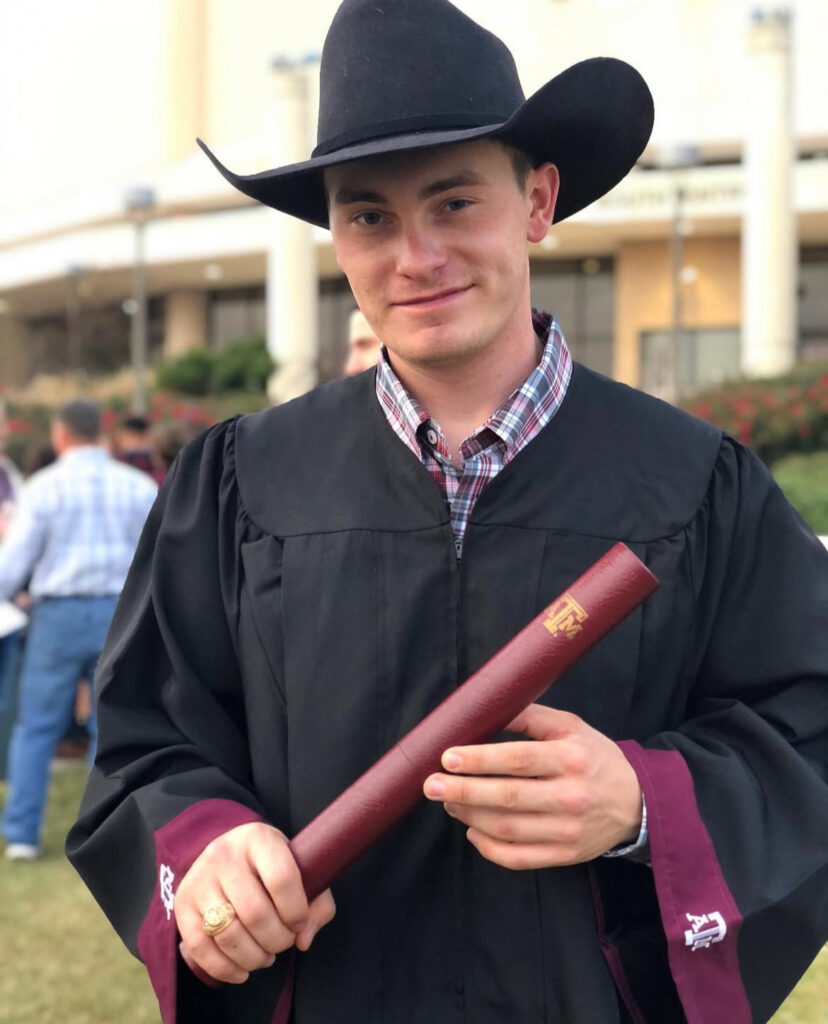
Carson Jeffery at his graduation from Texas A&M University in December 2019
-Carson Jeffery at his graduation from Texas A&M University in December 2019

Carson Jeffery discovered his passion for country music during his time at Texas A&M. Raised in a rodeo family in Cat Spring, Texas, Jeffery’s musical journey began in college, where he started performing for friends and local audiences. His authentic storytelling and heartfelt performances have positioned him as a rising star in the Texas country music scene. Since graduating, Jeffery has built a strong following in the Texas music circuit. Albums like “Heart of This Man” and “Fair Weather” showcase his signature blend of Red Dirt country and traditional influences. His live performances have earned him a reputation for raw, high-energy shows that reflect his deep love for country music.


Hayden Haddock ’21

Hayden Haddock outside of the Dixie Chicken his sophomore year of college
-Hayden Haddock outside of the Dixie Chicken his sophomore year of college

Hayden Haddock, a class of 2021 Texas A&M graduate, has rapidly emerged as a notable figure in the Red Dirt country scene. Balancing his studies in construction science with a flourishing music career, Haddock performed over 100 shows annually while still in school. His song “Where You Come In” gained significant traction, becoming the second most downloaded song on Texas radio at the time. Post-graduation, Haddock’s career has continued to ascend. He has celebrated five Top 15 Texas Country singles, including “Front Porch in the Rain,” and was named New Male Vocalist of the Year at the 2021 Texas Regional Radio Report Awards. With over 10 million streams and performances alongside artists like Randy Rogers Band and Wade Bowen, Haddock’s dedication to traditional country music and authentic storytelling underscores the ongoing influence of Texas A&M alumni in the genre.


Dylan Gossett ’21

Dylan Gossett with his family at his graduation from Texas A&M

-Dylan Gossett with his family at his graduation from Texas A&M

Austin native Dylan Gossett attended Texas A&M before making waves in the country music scene. He has sold out multiple shows, playing songs from his two EPs and drawing comparisons to artists like Parker McCollum. His single “Coal” has garnered significant attention, approaching 300 million streams on Spotify. Gossett’s songwriting captures personal and universal themes, resonating with fans who appreciate his honest and emotional lyrics. His rapid rise in the independent country scene proves that Aggies continue to influence the genre, bringing fresh perspectives and sounds to country music.


Bonus: Texas A&M has produced more than just country stars. Check out this KAMU interview with Colin Padalecki from the triple-platinum duo Surfaces from our original series “Texas A&M Today.”

KAMU Kids Programming Schedule & Updates

KAMU loves PBS KIDS! On our main channel, we air kids programming every weekday from 5 a.m.-1 p.m., Saturdays from 5 a.m.-11 a.m. and Sundays from 5 a.m.-12 p.m.

Across all of our children’s programming, we remain dedicated to offering fun, educational content covering a broad age appeal and curriculum topics. Plus, have you checked out our 24/7 PBS KIDS Channel? Watch through an antenna on channel 12.3 or Optimum 18. Or, a 24/7 livestream is available on PBSKIDS.org or the free PBS KIDS Video app on iOS, Android, Roku, Samsung Smart TV, Apple TV, Android TV, Amazon Fire TV, VIZIO SmartCast TV and Chromecast.

Plus, there are additional high-quality PBS KIDS programs available only for streaming through the app. Check out our list of additional resources at the end of this article for more details.

Parents, here’s a summary of our current schedule:

  1. KAMU Schedule (12.1)
    1. Weekday Schedule
    2. Weekend Schedule
  2. PBS KIDS Schedule (12.3)
    1. Weekday Schedule
    2. Weekend Schedule
  3. Additional Resources

KAMU Schedule (12.1)

Weekday Schedule

The weekday PBS KIDS schedule with changes as written out below.
We’ll kick off our summary with the weekday schedule on our main channel:
  • 5 a.m.: “Arthur”
  • 5:30 a.m.: “Odd Squad”
  • 6 a.m.: “Wild Kratts”
  • 6:30 a.m.: “Weather Hunters”
  • 7 a.m.: “Lyla in the Loop”
  • 7:30 a.m.: “Carl the Collector”
  • 8 a.m.: “Daniel Tiger’s Neighborhood”
  • 8:30 a.m.: “Rosie’s Rules”
  • 9 a.m.: “Sesame Street”
  • 9:30 a.m.: “Work It Out Wombats!”
  • 10 a.m.: “Donkey Hodie”
  • 10:30 a.m.: “Pinkalicious & Peterrific”
  • 11 a.m.: “Elinor Wonders Why”
  • 11:30 a.m.: “Alma’s Way”
  • Noon: “Molly of Denali”
  • 12:30 p.m.: “Xavier Riddle and the Secret Museum”
  • At 1 p.m., flip to PBS KIDS (12.3 or Optimum 18) to keep the children’s programs coming.

Weekend Schedule

The weekend PBS KIDS schedule with changes as written out below.

The weekend schedule continues to resemble the weekday schedule more closely than ever.

  • 5 a.m.: “Mister Rogers’ Neighborhood”
  • 5:30 a.m.: “Arthur”
  • 6 a.m.: “Wild Kratts”
  • 6:30 a.m.: “Weather Hunters”
  • 7 a.m.: “Lyla in the Loop”
  • 7:30 a.m.: “Carl the Collector”
  • 8 a.m.: “Daniel Tiger’s Neighborhood”
  • 8:30 a.m.: “Rosie’s Rules”
  • 9 a.m.: “Sesame Street”
  • 9:30 a.m.: “Work It Out Wombats!”
  • 10 a.m.: “Donkey Hodie”
  • 10:30 a.m.: “Pinkalicious & Peterrific”
  • That’s it for Saturdays, but the fun continues for one more hour on Sundays, including “Alma’s Way” at 11 a.m. and “Cyberchase” at 11:30 a.m.

PBS Kids Schedule (12.3)

We continue to take ages into account with toddler and Pre-K focused content from 6 a.m.-12 p.m., and an after-school focus for older kids from 2-5 p.m.

Weekday Schedule

the weekday PBS KIDS schedule with changes as written out below.

First, here’s what’s up on weekdays:

  • 5 a.m.: “Clifford the Big Red Dog”
  • 5:30 a.m.: “Sesame Street”
  • 6 a.m.: “Pinkalicious & Peterrific”
  • 6:30 a.m.: “Curious George”
  • 7 a.m.: “Sesame Street”
  • 7:30 a.m.: “Milo”
  • 8 and 8:30 a.m.: “Work It Out Wombats!”
  • 9 and 9:30 a.m.: “Daniel Tiger’s Neighborhood”
  • 10 a.m.: “Carl the Collector”
  • 10:30 a.m.: “Carl the Collector”
  • 11 and 11:30 a.m.: “Donkey Hodie”
  • Noon: “Elinor Wonders Why”
  • 12:30 and 1 p.m.: “Rosie’s Rules”
  • 1:30 p.m.: “Xavier Riddle and the Secret Museum”
  • 2 and 2:30 p.m.: “Alma’s Way”
  • 3 p.m.: “Lyla in the Loop”
  • 3:30 p.m.: “Arthur”
  • 4 p.m.: “Odd Squad”
  • New show “Skillsville” debuts at 4:30 p.m.
  • 5 and 5:30 p.m.: “Wild Kratts”
  • That leads into the PBS KIDS evening schedule, which includes a second airing of “Lyla in the Loop” at 6 p.m., and later, “Molly of Denali,” “Hero Elementary,” “Cyberchase” and “Let’s Go Luna!”

Weekend Schedule

The PBS KIDS weekend schedule with changes as written out below.

There’s more variety on the weekends, but a large chunk of the schedule resembles the weekday schedule.

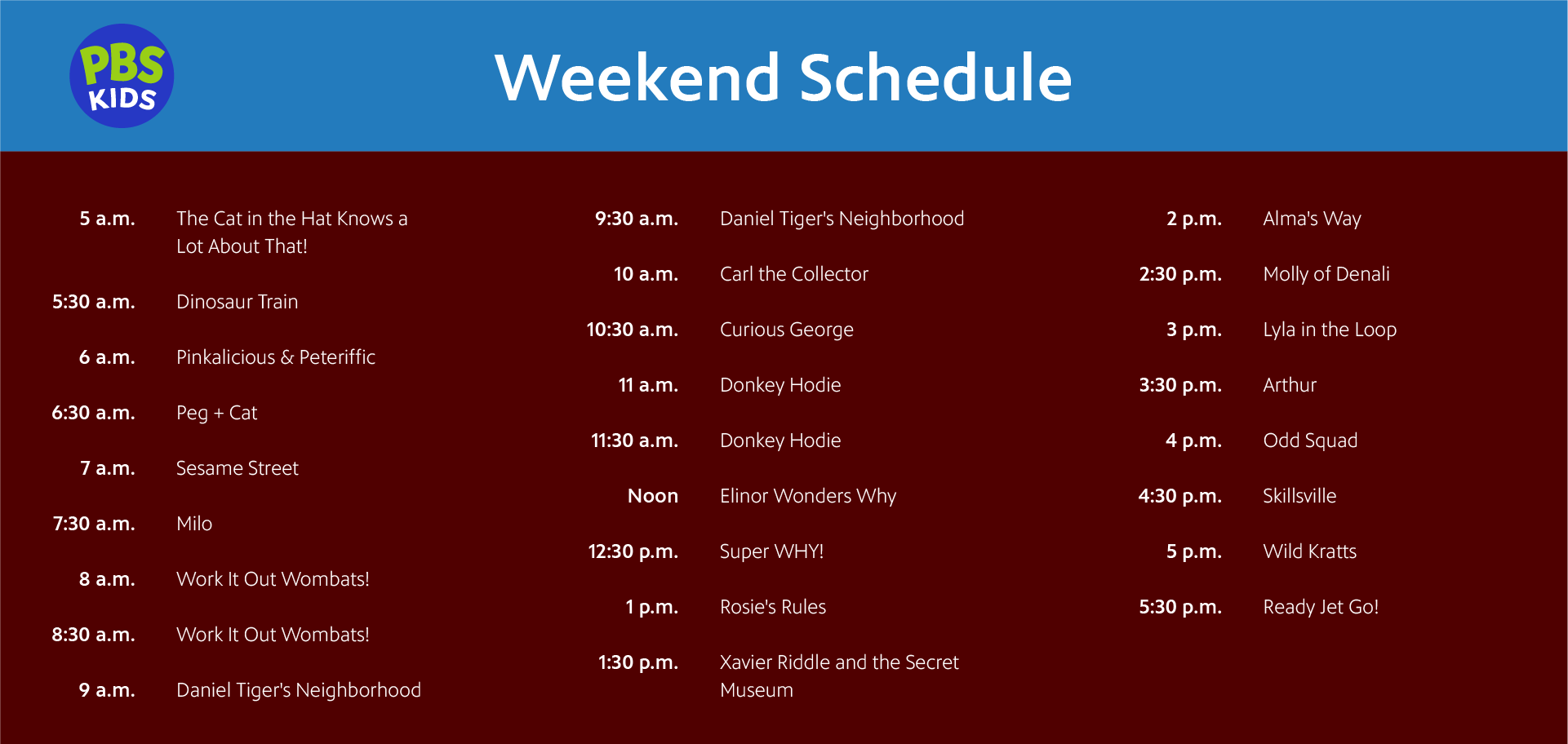
  • 5 a.m.: “The Cat in the Hat Knows a Lot About That!”
  • 5:30 a.m.: “Dinosaur Train”
  • 6 a.m.: “Pinkalicious & Peteriffic”
  • 6:30 a.m.: “Peg + Cat”
  • 7 a.m.: “Sesame Street”
  • 7:30 a.m.: “Milo”
  • 8 and 8:30 a.m.: “Work It Out Wombats!”
  • 9 and 9:30 a.m.: “Daniel Tiger’s Neighborhood”
  • 10 a.m.: “Carl the Collector”
  • 10:30 a.m.: “Curious George”
  • 11 and 11:30 a.m.: “Donkey Hodie”
  • Noon: “Elinor Wonders Why”
  • 12:30 p.m.: “Super WHY!”
  • 1 p.m.: “Rosie’s Rules”
  • 1:30 p.m.: “Xavier Riddle and the Secret Museum”
  • 2 p.m.: “Alma’s Way”
  • 2:30 p.m.: “Molly of Denali”
  • 3 p.m.: “Lyla in the Loop”
  • 3:30 p.m.: “Arthur”
  • 4 p.m.: “Odd Squad”
  • 4:30 p.m.: “Skillsville”
  • 5 p.m.: “Wild Kratts”
  • 5:30 p.m.: “Ready Jet Go!”
  • Then, it’s PBS KIDS family night.

Additional Resources

These programs are always available to stream on-demand:

  • “Sid the Science Kid”
  • “WordWorld”
  • “Splash and Bubbles”
  • “Martha Speaks”
  • “WordGirl”

If your kids are missing episodes of these shows and more, pull up the PBS KIDS website on your computer, phone or tablet, or the PBS KIDS Video app on your iOS or Android devices or Kindle tablet. Your kids can watch episodes of their favorite shows on-demand. Plus, the PBS KIDS Video app even allows several shows to be downloaded for your convenience.

KAMU appreciates the loyal support and loves bringing fun, educational programming to children of all ages. This schedule update will remain available to view whenever you have questions. You can also visit our PBS KIDS schedule page if you’re looking for a specific program or a single day’s schedule.

Additionally, visit our KAMU Kids Corner! Our Learning page has lots of fun games, resources and coloring pages you can print out for your kids. We have a community page, too, with links to fun community events and a photo gallery. Plus, the PBS KIDS website has fun games for all ages. And parents, there’s a website for you, too, full of PBS KIDS resources to help your children grow, learn and thrive.

“Play is often talked about as if it were a relief from serious learning. But for children, play is serious learning. Play is really the work of childhood.” – Mister Rogers

How Marie Antoinette is Connected to Texas A&M

“Qu’ils mangent de la brioche” – or in English, “let them eat cake.” Did Marie Antoinette actually say that? Probably not. But she did say a lot of things – and they’re about to be dramatized on TV and streaming devices for you.

It’s time to return to revolutionary-era France as the convoluted tale of a young queen continues on KAMU. Season 2 of “Marie Antoinette” airs Sundays at 9 p.m., premiering March 23. Or if you’re a KAMU Passport member, you can binge all six episodes the night of its TV debut.

Catch up on Season 1, which aired in 2023 on KAMU.

The French Revolution may have happened over 225 years ago and 5,000 miles away, but this TV show isn’t our only connection to that era of French history in Bryan-College Station.

The Dawson French Collection

Visiting Texas A&M’s Cushing Memorial Library & Archives is like stepping back in time. The 1920s architecture remains well maintained. But the architecture wraps around something even rarer: special collections like the Robert L. Dawson French Collection.

Shelves and shelves and shelves of French books, manuscripts, plays, letters and more – a total of more than 20,000 items – live in a climate-controlled area in a closed stack. The Dawson collection is one of the finest French literature collections this side of France – and it’s owned by Texas A&M.

“We have items in our collection and the only other institution that may own a copy is the National Library of France,” said Felicia Piscitelli, rare books cataloger and curator of the Dawson French Collection. “Or we may have the only copy. We have some pretty neat stuff.”

Piscitelli has cataloged books at Cushing since 2009 and took over curatorship of the Dawson collection in 2022. She said the collection’s strength is in the 18th century, but that it spans more: from roughly the 15th century to the first half of the 20th.

“It has a great deal of scope,” she said. “Literature, writings, essays, poetry, drama, a lot of theater and opera. Religious works.”

There are writings of Voltaire, collections of French laws dated with the revolutionary calendar, one of the first printings of “Les Miserables,” an official dictionary, magazines for young ladies, documents establishing public libraries and more.

“Books like these are not easy to get,” Piscitelli said.

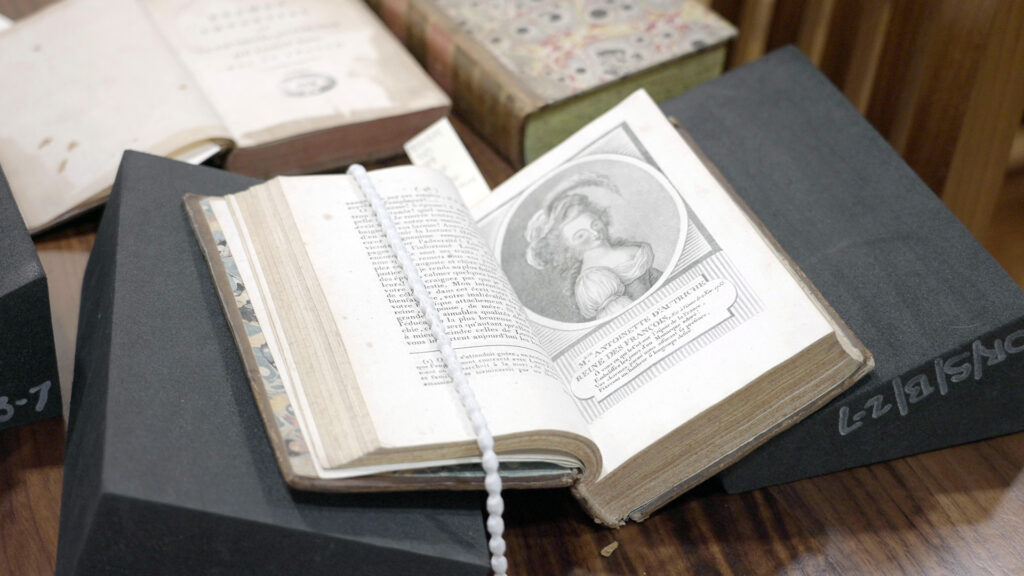
An old book featuring an etched portrait of Marie Antoinette.

Who Was Robert Dawson?

Americans aren’t always welcomed overseas, but Robert Dawson wasn’t an ordinary tourist. Known as an avid collector, he frequented the bookshops and auction houses of Paris with delight, so well-known that he was greeted as a friend. He was as enamored with forgotten authors as he was with famous names like Voltaire and Jean-Jacques Rousseau.

But Austin, Texas, was his home. Dawson worked as a French professor at the University of Texas from 1975 until his death in 2007. He had two degrees from Yale, was fluent in French and Portuguese and proficient in Italian and Spanish, and he kept the majority of his collection in his cramped university office, packing every free inch with shelves.

An exhibit catalog produced by Cushing in 2008 said even the shelves weren’t enough: “The floor was covered with boxes and bags of books and the lone desk had long since surrendered its original role as a work surface in favor of being another spot to stack new arrivals or old gems.” He made his library available to anyone – serious researchers and curious students alike. It was never meant to be looked at; it was always meant to be used.

The Cushing Library acquired the collection from Professor Dawson a few years before his death and brought it to College Station. It took two large rental trucks and a minivan. “The movers planned for only one truck,” the catalog said, “but part way into the move added another out of fear the load would burst the tires.”

A Living, Breathing Collection

The majority of the collection may be more than 200 years old, but each page still tells a relevant story.

“Collections like this give us a sense of how we got to where we are,” Piscitelli said. “If we forget what happened in the past, we’re likely to repeat it. The French Revolution – do we really want to go through that again? I don’t think so.”

Piscitelli described an inherent vibrancy to the collection – almost as if the love, care or anger put into each work can be felt and seen.

“After a while, you get to know authors and publishers in a familiar way,” she said. “You start to recognize the unique ways they do things.”

Much of the collection remains in good shape. In the 1700s, Piscitelli said bindings were more substantial and paper was made from linen or cotton rag.

“The fibers are less acidic and stronger than wood pulp paper, which came about in the late 19th century,” she said. “Books printed in the 1880s or 90s are already crumbling, whereas books from the 1790s are still in better condition.”

Curators have kept Professor Dawson’s vision alive over the years by sharing the collection with language classes and researchers. They also keep it growing. Piscitelli adds items that are topical and fit into the time period.

“My latest purchase was printed in 1699 and it’s a collection of essays asking when the new century starts: 1700 or 1701,” she said. “It’s like Y2K 300 years earlier.”

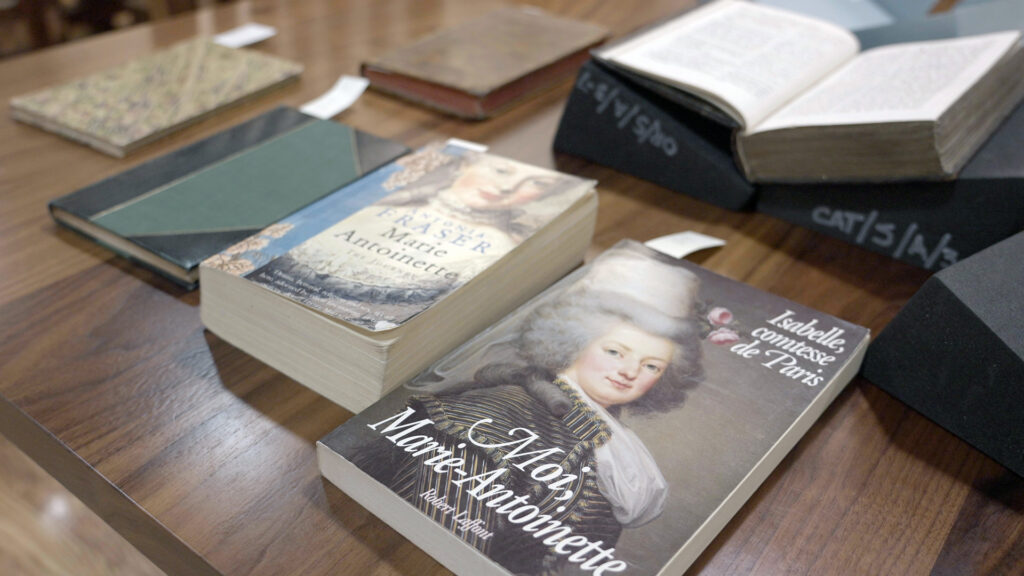
Two newer biographies of Marie Antoinette lay on a table.

Marie Antoinette

The collection features many items from the revolutionary period. Piscitelli browsed the collection to find a few referencing Marie Antoinette. There’s a defamatory book of essays about her life, published in 1789.

“The year the revolution started and they were already saying bad stuff about her,” Piscitelli said.

Marie Antoinette was regularly criticized as the French people became more and more unhappy with the monarchy. There’s a book from 1794 tying her to causes for the revolution. And there’s a memoir supposedly written by Madame Comtesse de la Motte detailing the Affair of the Diamond Necklace, in which Marie Antoinette was falsely accused of defrauding jewelers, further ruining her reputation with the public.

But there are also items in support of the king and queen. There are funeral elegies for Louis XVI. There’s a 20,000-signature petition defending the king from revolutionary threats. And there’s a Latin prayer book, translated and dedicated to the queen.

Making the Collection Available

Most of the collection is properly cataloged, but Piscitelli estimates she has at least 1,000 titles left. She puts her undergraduate French minor to work reading documents, analyzing authors and scouring bibliographic sources to identify each item and write a proper description. She’s also looking for printing errors. They make items even rarer – and it’s important to include those details in descriptions.

“It will take a long time to get through the last thousand,” she said. “The description for rare books is more involved than it is with modern books.”

Piscitelli encourages interest in using the collection. She’s worked with enough rare books by now to know not everything is digitized.

“There’s an idea that everything is available online now, but that is not the case,” she said. “Plus, the likelihood that you can go on Amazon or eBay and get a book like this is pretty dicey.”

Every item in the catalog is available to request and view in the Kelsey Reading Room at Cushing. Interested students, teachers or researchers should visit the library website, which explains the process for requesting items and scheduling time to view them. Au revoir!


Watch “Marie Antoinette” on KAMU, premiering Sunday, March 23 at 9 p.m. Want to learn more about the new season? Check out this PBS article for previews, casting news and more. 

A Tex-Pert’s Guide to Spring Break | The Daytripper

Spring break is almost here. Kids, college students and even parents are counting down the hours until vacation begins.

But where to go? Many gravitate toward the beach, but Texas – with its vast size and regional diversity – offers countless other unique destinations to explore.

To help you decide, we enlisted a true Texas expert, or Tex-pert, if you will. This man knows Texas better than anyone, since it’s his job to explore every nook and cranny of our beloved state. His name is Chet Garner – aka The Daytripper.

“We all know what’s coming this summer,” Chet says. “It’s going to be a giant blow dryer to the face. Enjoy the good weather while it’s here.”

We asked Chet to share his top Texas spring break recommendations. He gave us tips for a great week-long vacation, plus some smaller day trips around the Brazos Valley region – and even a few suggestions here in Bryan-College Station if you’d rather stay close to home.

For more of Chet’s adventures, tune in to “The Daytripper” every Wednesday at 1 p.m. and Saturday at 6 p.m. on KAMU.

Take a Trip

Chet’s number one tip for spring break? Spend time outdoors.

“The weather couldn’t be better,” Chet says. “You’re going to be complaining in July and August that you can’t go outside. So what did you do when you could? Right now, spring break, it’s time – go outside.”

For Families

“Kids need to go outside,” Chet says. “We’re so hooked to our screens now but this is a wonderful chance to get them into the great outdoors.”

  • Enchanted Rock. Chet says this should be at the top of anyone’s list. “It’s like God took a big ol’ granite basketball, chopped it in half and put it in the hill country,” Chet says. If you have small kids, give them a chance to hike and if it’s not working, a backpack carrier is a great option.
  • Angelina National Forest. Visit the piney woods of East Texas for some great hikes. Chet recommends Boykin Springs: a great place to explore and hike, including a 2.75-mile trek to the abandoned Aldridge Sawmill historic site.
  • Brazos Bend State Park. On a sunny day, head to this park south of Houston to see alligators. They can often be spotted sunning themselves near the trails.

For College Students

“This is prime road trip season,” Chet says. “Head west or north. Go do those things that take a little more time.”

  • Big Bend National Park. “I had my first trip to Big Bend when I was in college,” Chet says. “It changed my world, it blew my mind.”
  • Davis Mountains. “Yes, we have mountains in Texas,” Chet says. “If you’ve only ever seen College Station and Houston you don’t know that.” Plus, enjoy a star party at the McDonald Observatory and see some of the most beautiful night skies on Earth.
  • Palo Duro Canyon. The second largest canyon in the United States is a long drive from College Station but worth it. “Load up your buddies, throw in a tent or find a little Airbnb – that’s the college kid experience,” Chet says.
  • Caddo Lake State Park. Texas has just one natural lake. Why not go experience it? Located along the Louisiana border, it’s a swamp with cypress trees and winding kayak paths. “During the springtime, the swamp that’s been dormant all winter starts to bloom and it’s gorgeous,” Chet says. “You didn’t think you loved the swamp but I’m telling you, it is one of the most beautiful places in Texas.”


Skip the Beach…

Party beaches usually grab the spotlight for college spring break, but Chet says it’s just not the best time to head to the coast.

“I think it’s a terrible time to go to the beach,” Chet says. “It’s not quite warm enough to swim. You get the crowds but not the sun.”

…Don’t Rush…

Chet’s biggest advice: let the road take you where it will. “Don’t try to rush to get to the destination, enjoy the journey,” he says. “Stop and bobble around as you go along – that’s the joy of the trip.”

…And Load Up

Once you know your destination, get your starter pack ready to go.
The Daytripper Starter Pack.

  • Food! “You can’t go on a road trip without snacks, right?” Chet says. “Go to the gas station and just load up on garbage. You shouldn’t eat it all the time, but it wouldn’t be a road trip without it.” Chet recommends gas station hot dogs, and once you get out west, an Allsup’s beef and bean burrito (editor’s note: this is an underrated recommendation).
  • Plan for Camping. If you’re going to camp, you do need to plan a little bit. Yes, grab the tent and sleeping bag, but we’re talking about location. State parks fill up quick so go online and make a reservation in advance – it’s not really something you can play by ear during a busy week like spring break.
  • Swimsuit. “It’s not the warmest time, but the water will probably feel good regardless,” Chet says.
  • Camera. To take pictures of all the memories!
  • Toothbrush? “Bring a toothbrush if you want, but you can really live on very little for a few days,” Chet says.

Take a Day Trip

If you don’t have the time for a full adventure, not to worry! There are plenty of fun day trips a few hours from the Brazos Valley.

“Bryan-College Station is in a great day trip zone,” Chet says. “Plus, for a day trip, you don’t have to find someone to feed your dog,” Chet says. “Throw the dog in the car, it can come.”

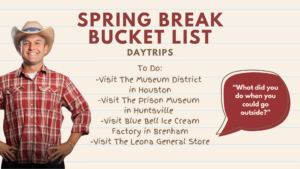
Spring Break Bucket List: Daytrips. To Do: Visit the Museum District in Houston, Visit the Prison Museum in Huntsville, Visit Blue Bell Ice Cream Factory in Brenham, Visit the Leona General Store.

  • Museum District in Houston. “The best museums in the country are right there in Houston,” Chet says. He recommends the Museum of Natural Science and The Museum of Fine Arts.
  • Prison Museum in Huntsville. “Really weird, fun day trip,” Chet says. “But I guarantee you’re going to like it.” Find fascinating, strange and fun history just an hour from Aggieland.
  • Blue Bell Ice Cream Factory in Brenham. A short but tasty day trip! Who doesn’t love ice cream?
  • Leona General Store in Leona. Only open on weekends for dinner, it’s widely known for amazing steak. Get there early, though – it’s a little store in a small town along I-45 but people line up hours before opening. “One of the best steaks you’ll ever have in your life,” Chet says. They’re also open on Thursday evenings for catfish night.
  • Paddle the Colorado River in La Grange. A wonderful way to spend a warm Texas day. Find a canoe rental place around La Grange and paddle to your heart’s content.

Stay and Explore

If you can’t travel or don’t want to travel for spring break, there’s still a lot to explore in Bryan-College Station. Chet may be a longhorn alum but he loves exploring this area and has some favorites to share.

Chet Garner standing in front of a Spring Break bucket list to-do list

  • Mountain Biking at Lake Bryan. “It’s right under people’s noses,” Chet says. “When I was in school in Austin, I visited a buddy in College Station and he said ‘bring your mountain bike.’ I didn’t believe him but it was so much fun.”
  • George H.W. Bush Presidential Library. You may have driven past the museum dozens of times but have you ever stopped in? “Don’t write it off as a lame, boring museum,” Chet says. “Every presidential library is an awesome experience.” Tip: bring your Texas A&M or Blinn student ID and you get in free!
  • Downtown Bryan. If you haven’t strayed far from Northgate, spring break is a perfect time to visit Downtown Bryan. “Great coffee, great barbecue, great drinks,” Chet says. “I love the Dixie Chicken, don’t get me wrong, but maybe wander up the road a little bit.”

About The Daytripper

“The Daytripper” is now in its 15th season on KAMU.

“We all want to have adventures, we love experiences,” Chet says. “What we don’t realize is there are so many amazing things right under our noses that we’re just totally missing.”

Chet loves to travel and wants to inspire others to enjoy it, too. But the biggest misconception is that travel has to involve an exotic location.

“Then you have to take all this time off of work and find someone to water your plants,” he says. “No, no, no, just hop in your car and go – that’s really it.”

Chet Garner rides a lizard statue during filming of The Daytripper

If you’re looking for a travel guide, you’ve come to the right place. Big cities, small towns, hidden gems – “The Daytripper” hits them all. But after 173 episodes, will he ever run out of places to go?

“People ask me that all the time and I’m like ‘do you live in the same state I live in?'” Chet says. “It’ll never happen.”

Opportunities to travel abroad in college and law school inspired Chet to start the show. When he would talk to people overseas, all of them wanted to come to Texas.

“It really spun my mind to realize we live in a place the rest of the world wants to come and see,” he says.

Bottom line: go out and experience the uniqueness of Texas. Enjoy it. Adventure awaits!


Watch “The Daytripper” on KAMU every Wednesday at 1 p.m. and Saturday at 6 p.m. Check our TV schedule for specific episode listings.

For more on “The Daytripper,” visit the show website or watch past episodes on the show’s YouTube channel.

Support KAMU TV-FM in our mission to inspire, enrich and educate.

Donate Now