The words “We remember” are etched on the hearts of so many Americans who lived through the tragic events on Sept. 11, 2001. But what significance does that day hold for the younger generation that never witnessed it? Most undergraduates today were born after the attacks. I am part of that generation, and for us, “never forget” takes on a different meaning.
My parents and mentors can tell you where they were when the first plane struck. I can’t. My memories of 9/11 begin in a classroom.
Year after year, as the anniversary approached, teachers would turn off the classroom lights, turn on the projector and display videos that would give us a glimpse into that morning. I remember watching the chaos: smoke coming from the towers, debris pouring down on people, panic on the streets of New York City and the first responders rushing toward the danger everyone else was trying to escape.
Even though I knew how the story ended, I found myself feeling anxious and hopeless. Those lessons fascinated me, but more than anything, they made me somber. They still do.
 When I was 9, my parents took me to ground zero, the site where the World Trade Center’s two towers once stood. Even at that age, I could feel the impact of what had happened there 13 years earlier. I may not have fully understood the extent of the tragedy as I do now, or the thousands of lives lost, but I understood that I was standing somewhere that carried immense loss and meaning.
My eyes widened and my chest felt heavy as I looked at the exhibits in the National September 11 Memorial and Museum. What I had only seen through classroom screens suddenly felt real.
As a child, I found it difficult to fully wrap my head around the magnitude of what I was watching. But as I’ve grown older, I have come to understand that those classroom videos were more than just history lessons. They were an act of remembrance. Every teacher who turned off those lights was doing their part to make sure we never forget.
As the years pass, remembering becomes increasingly dependent on storytelling from those who experienced the tragedy firsthand. We can learn from them and understand why a day that happened before our lives began continues to shape the country we call home.
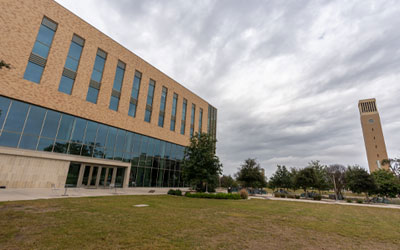
On the 25th anniversary of 9/11, The Bush School of Government and Public Service at Texas A&M University held remembrance ceremony at the Annenberg Presidential Conference Center. There, I heard from members of the Texas A&M community who had lived through that day.
Retired U.S. Marine Corps Col. Mike Reilly, who was in the Pentagon during the attacks, now serves as the Bush School’s director of Undergraduate Studies with the Public Service and Administration.
“We must educate our next generation of public servants,” Reilly said, “so that they can protect our homeland and we can ensure it remains prosperous and secure, that we can be a force for good out in the world.”
Following the powerful testimonies in the auditorium, we gathered around the Bush School pond as 2,977 miniature flags stood planted in the lawn to honor each person killed in the 9/11 attacks.
John B. Sherman, dean of the Bush School, stood at the center of the lawn with a bullhorn in hand. Sherman was a CIA analyst working in the White House Situation Room during the attacks. He recalled former President George W. Bush speaking through a bullhorn at ground zero just days after the attacks, then reflected on what it means to remember the lives lost and the sacrifices made that day.
“We need to be worthy. As we say here at Texas A&M: we’re a force for good, all of us,” Sherman said. “Let’s be a force for good and remember who they were so we can know who we should be.”
Nathan Harness, an instructional professor and director of the Financial Planning Program at Texas A&M, was only 22 and on his second day on the job with Morgan Stanley when the attacks began. He spoke at the ceremony and shared his story in an interview with KAMU.
Harness started the morning in the South Tower and recalled looking out the windows of the 61st floor seeing smoldering papers floating in the sky and wondering what had gone wrong. Minutes later, he and his coworkers were told to evacuate. They were descending a stairwell when the second plane struck their tower, knocking him to his knees and plunging the stairwell in darkness.
Harness recalled what he assumed would be his final thoughts. “In that moment, to me it feels like this is my final tomb,” he said. “This will be my resting place with strangers that I do not know.”
When the emergency lights came, Harness could see cracks in the drywall and panic among the people around him. “In that stairwell, we were at the mercy of every single person in front of us,” Harness said. Looking back, he thinks about “the multitude of people who came together as Americans, to sacrifice themselves for others.”
He remembers the people who stopped to help. “I think what sometimes gets lost in the story is the sacrifice of average Joe and Jane, who were in a stairwell together and took the time to pick somebody up.”
After escaping the building, Harness ran across the street and looked back to see what he described as a “gaping, flaming hole” in a tower. He said that he followed his impulse to keep running and did so until he reached the Central Park area. Along the way, he said, he could hear the towers collapsing behind him.
In the days after, Harness made his way back home to Arkansas, forever changed.
Watch his full recollection of that day on KAMU’s YouTube channel:
Harness wants to ensure that the generations that came after him understand the significance and impact of that tragic morning.
“I cannot repay in kind the sacrifice of individuals who gave their lives,” he said. “But what I can do is live on their behalf. I can live a life fully. I can invest in the next generation, and I can tell their story so that we remember what matters.”
For my generation, “never forget” cannot mean remembering where we were that morning. We weren’t there. Instead, it means choosing to listen and learn from those who were. It means listening when people like Harness share their stories. It means understanding the sacrifice of the first responders who ran toward danger. It is pausing to recognize the 2,977 lives lost on that day and refusing to allow their stories to become nothing more than just a page in a history book.
Watch the livestream of the Bush School’s 9/11 Remembrance Ceremony:
Published: September 2026
Written by: Kazzandra Romero ’28